Wednesday, March 24, 2010

Note on CCS Policy

There are limits to what you can say in 140 charachters so here is a quick note on my thougts about CCS. I`m not an expert but it is a topic that i have been looking at for some time.

I started out enthusiastic about CCS and annoyed with environmentalists who where against the technology. My positions was due to my concern about the development of China and India and the potential for shifting these economies over to renewable forms of power(1).

However, after reading a superb report (2) by the Wuppertal institute i started to question both the merrits of ccs and the promise when compared to alternatives. The big point that comes out of this report is that when you consider total carbon emissions from coal rather than just the percentage of emissions that you can capture from the coal you end up with carbon reduction of around 65% rather than 90% when we look purely at direct coal emissions.

It is also worrying to me that by simply swapping coal for coal + ccs will give you a more pollouting plant in terms of local air quality. Given the air quality in asia i do have some feeling about the morality of promoting a very expensive and more pollouting form of power that has the sole advantage of reducing carbon emissions.

I realise that there is some interest in these technologies within Russia, hopefully more than in asia. I don't have references to hand but i did some reading on political/technical/scientific opinions in China about CCS and the attitude was one of extreme skepticism. Let me know if you want the paper.

These are my concerns about CCS. With limited govornment budgets i do think that offshore renewables should be a priority for the UK. So i do have some concerns about expenditure on CCS displacing expenditure on what i think deserve to be national priorities exploiting our natural advantage.

If money is to be expended on CCS technologies then i would not disagree with this so long as the warnings of the Environmental Audit Committee are taken seriously:
'“The possibility of ccs should not be used as a fig leaf to give unabated coal-fired power plants an appearance of environmental acceptability” .

In order for CCS to be seen as anthing other than an expensive and distracting measure, it will have to be tested on entirel ccs plants, not 20% CCS plants. Indeed, we alread have plenty of old coal plants to test post-combustion technology on.


REF:

(1)
My initial view that CCS isn't nessicary for UK electricity supplies and is more usefully considered an export technology is unchanged. We have a vast offshore wind resource, soon to be quantified more acurately by Boston Consulting Group. The key question is one of transmission: r&d and investment in infrastructure would be an alternative to investing in CCS which is VERY expensive.

(2)
The Wuppertal institue report is so notable because it looks not only at emissions per net unit of energy produced, but also at transport, mining and processing emissions.
http://www.wupperinst.org/en/projects/proj/index.html?projekt_id=25&bid=155

(3)

http://www.parliament.uk/parliamentary_committees/environmental_audit_committee/eac_220708.cfm

Labels: ,

Climate Change Action

Home furl google deliciousdel.icio.usnetvouz newsvine diggDigg This!reddit spurl Technorati

Enter your Email


Preview | Powered by FeedBlitz

Tuesday, May 26, 2009

UK Climate Policy?

Things are getting tough for Ed Miliband. It looks like fudging the issues isn't the same as providing leadership.

Labels: , , , , ,

Climate Change Action

Home furl google deliciousdel.icio.usnetvouz newsvine diggDigg This!reddit spurl Technorati

Enter your Email


Preview | Powered by FeedBlitz

Saturday, May 09, 2009

UK Coal Policy + CCS

Labels: , , , ,

Climate Change Action

Home furl google deliciousdel.icio.usnetvouz newsvine diggDigg This!reddit spurl Technorati

Enter your Email


Preview | Powered by FeedBlitz

Monday, May 04, 2009

CCS: Can we beat the offer?

We need to reduce the carbon output of of electrcity sector dramatically. Govornment and industry have been convinced that we the people arent going to back down on this point. So the question is: what are the solutions being offered? Nuclear power is on the table and as soon as it becomes economically feasible I'm sure british power companies will dispatch carrier-pigs to deliver the news to the department of energy and climate change. In the mean time, there are new ideas.

Offer #1 Is carbon capture and storage(CCS). Offer #1 promises many of the negatives of standard coal power with some added complications, a reduction in efficiency and a long term waste storage issue. On the positive side it can mitigate climate change at a cost somewhat lower than the construiction of hydrogen powered jet planes.

Offer #2 is a selection of renewables at any proportion up to around 20%. We are told that our highly ordered national grid can deal with a little of our idealism, a minor insurgency of these intermitent and imppractical sources of power can be accepted.

The more perceptive amongst you may have noticed that Offer #2 leaves atleast 80% of our decarbonisation undone. So the question is, can we beat CCS as a solution?

The bar seems to have been set rather low by this question. CCS plants would generally pollute more than coal, would use more water, would have higher capital requirements and more maintaince staff than coal. They would offer but one advantage: less carbon dioxide emitted. The idea that the world is going to move from one inneficient a polluting technology to an even less efficient and more polluting technology that costs more is a little hard to swallow.

From the outset we can name renewables which cause negligible degrees of air and water pollution as well as eliminating water consumption. We then have to look at costs, which for wind can be lower than standard coal already, and which will only go down with production capacity increases. Finally, we are left with intermitancy and the status quo. We have to find a way of dealing with intermitent sources of power. We also need to find a way of convincing people that whilst is it certain that the great majority of our present electricity is derived from fossil fuels it is not certain that even a small minority of our future electricity will be produced that way. This may seem like simple terrain for an overheated argument about CCS but much of it comes down to the presuposition of important bodies that 'coal is going to play an important part in our energy future' and a rising clamour of voices stating that 'incalcation does not amount to a solid argument'.

Coal power is always going to be cheaper than coal power with ccs simply because ccs adds several post combustion stages of transport and storage. No such argument can be made about renewables. Whilst coal-ccs can optimistically offer only power 'almost as cheap as we have now'
renewable energy integrated through a well interconnected smart grid can potentially offer cheaper, more customizable, power whilst brining numerous ancillary benefits.

Basic smart grid technology includes automatic load shedding, real time pricing and alternative contracts for different power qualities. Fridges and air conditioning and heating with smart chips can stop temporarily when the mains frequency changes, reducing strain during what could be dangerous peaks in demand. Pricing can vary with supply and demand on a minute by minute basis, allowing the savvy consumer to reduce electricity bills while saving the electricity companies large summs on deffered infrastructure investments. Large customers may be able to sign up to an ineruptable power supply, if short power cuts do not offer major difficulties large savings could be made in this way; as a pay off the grid company gains a large chunk of load that can be shed at times of peak demand. In the future it may also be possible to have certain crucial equipment on very high quality power, suprassing anything available today, whilst having less time dependent appliances on a standard releability tarrif. These basic demand side management tools can be complimented by various kinds of storage. Fly wheels, flow batteries, ultra-capacitors, compressed air energy storage, pumped storage; the list of storage technologies is extensive. Most of these are suitable only for short term voltage maintainence, not for making up significant gaps in power supply as may result from drops in wind or clouding over. Pumped storage is the exception, but sighting is limited to geologically sound mountainous regions. Compresed air energy storage may be suitable for significant energy provision untill a backup generation facility can be fired up.

If we dont want to fire up backup generation then we have to move from temporal to spatial coping mechanisms. Use of high voltage transmissions lines over large distances can help by both smoothing out the renewable energy resource supplies and by allowing for the inclusion of more distant storage supplies. Although there are numerous challenges to be overcome, it does seem likely that a smart grid system with long range high voltage lines does offer the potential for a cleaner, low carbon electricity system with reduced demand on water resources for less than the cost of coal with carbon capture and storage. So don't forget: 'coal is going to play no part in our energy future'.

Labels: ,

Climate Change Action

Home furl google deliciousdel.icio.usnetvouz newsvine diggDigg This!reddit spurl Technorati

Enter your Email


Preview | Powered by FeedBlitz

Friday, February 27, 2009

Clean Coal Air Freshener

Now with a new and improved label! New Reality ad directed by the Academy-award winning Coen Brothers.

In reality, there's no such thing as clean coal. Learn more. Join the campaign.

Labels: , ,

Climate Change Action

Home furl google deliciousdel.icio.usnetvouz newsvine diggDigg This!reddit spurl Technorati

Enter your Email


Preview | Powered by FeedBlitz

Thursday, February 12, 2009

Coal Update

In the last few days my news filters have picked up the following about coal in the UK...

  1. An old article (why?) with an interesting statement from Paul Golby about the fact that basically the govornment have to look after his customers because that isnt his responsibility.
  2. Julian Cope on a discussion that covored clean coal at Leeds civic hall.
  3. A new website for your attention--publicservice.co.uk have a piece about climate change and energy.
  4. EON came second in Greenpeace's 'emerald paintbrush' award for greenwashing.
  5. EON staff are protesting about foreign workers being brought in to take 'british jobs'.
  6. The coal gasification plat being built in Hatfield may get 250M euros of funding from the EU to convert to CCS.
  7. EON sacks 19 of its 100 PR staff.

Labels: , , ,

Climate Change Action

Home furl google deliciousdel.icio.usnetvouz newsvine diggDigg This!reddit spurl Technorati

Enter your Email


Preview | Powered by FeedBlitz

Sunday, January 04, 2009

James & Anniek Hansen open letter to Michelle and Barack Obama

29 December 2008

Dear Michelle and Barack,

We write to you as fellow parents concerned about the Earth that will be inherited by our children, grandchildren, and those yet to be born. Barack has spoken of 'a planet in peril' and noted that actions needed to stem climate change have other merits. However, the nature of the chosen actions will be of crucial importance.

We apologize for the length of this letter. But your personal attention to these 'details' could make all the difference in what surely will be the most important matter of our times.

Jim has advised governments previously through regular channels. But urgency now dictates a personal appeal. Scientists at the forefront of climate research have seen a stream of new data in the past few years with startling implications for humanity and all life on Earth.

Yet the information that most needs to be communicated to you concerns the failure of policy approaches employed by nations most sincere and concerned about stabilizing climate.

Policies being discussed in national and international circles now, which focus on 'goals' for emission reduction and 'cap and trade', have the same basic approach as the Kyoto Protocol.

This approach is ineffectual and not commensurate with the climate threat. It could waste another decade, locking in disastrous consequences for our planet and humanity.

The enclosure, "Tell Barack Obama the Truth – the Whole Truth" was sent to colleagues for comments as we left for a trip to Europe. Their main suggestion was to add a summary of the specific recommendations, preferably in a cover letter sent to both of you.

There is a profound disconnect between actions that policy circles are considering and what the science demands for preservation of the planet. A stark scientific conclusion, that we must reduce greenhouse gases below present amounts to preserve nature and humanity, has become clear to the relevant experts. The validity of this statement could be verified by the National Academy of Sciences, which can deliver prompt authoritative reports in response to a Presidential requesti. NAS was set up by President Lincoln for just such advisory purposes.

Science and policy cannot be divorced. It is still feasible to avert climate disasters, but only if policies are consistent with what science indicates to be required. Our three recommendations derive from the science, including logical inferences based on empirical information about the effectiveness or ineffectiveness of specific past policy approaches.

(1) Moratorium and phase-out of coal plants that do not capture and store CO2. This is the sine qua non for solving the climate problem. Coal emissions must be phased out rapidly. Yes, it is a great challenge, but one with enormous side benefits. Coal is responsible for as much atmospheric carbon dioxide as the other fossil fuels combined, and its reserves make coal even more important for the long run. Oil, the second greatest contributor to atmospheric carbon dioxide, is already substantially depleted, and it is impractical to capture carbon dioxide emitted by vehicles.

But if coal emissions are phased out promptly, a range of actions including improved agricultural and forestry practices could bring the level of atmospheric carbon dioxide back down, out of the dangerous range.

As an example of coal's impact consider this: continued construction of coal-fired power plants will raise atmospheric carbon dioxide to a level at least approaching 500 ppm (parts per million). At that level, a conservative estimate for the number of species that would be exterminated (committed to extinction) is one million. The proportionate contribution of a single power plant operating 50 years and burning ~100 rail cars of coal per day (100 tons of coal per rail car) would be about 400 species! Coal plants are factories of death. It is no wonder that young people (and some not so young) are beginning to block new construction.

(2) Rising price on carbon emissions via a "carbon tax and 100% dividend". A rising price on carbon emissions is the essential underlying support needed to make all other climate policies work. For example, improved building codes are essential, but full enforcement at all construction and operations is impractical. A rising carbon price is the one practical way to obtain compliance with codes designed to increase energy efficiency.

A rising carbon price is essential to "decarbonize" the economy, i.e., to move the nation toward the era beyond fossil fuels. The most effective way to achieve this is a carbon tax (on oil, gas, and coal) at the well-head or port of entry. The tax will then appropriately affect all products and activities that use fossil fuels. The public's near-term, mid-term, and long-term lifestyle choices will be affected by knowledge that the carbon tax rate will be rising.

The public will support the tax if it is returned to them, equal shares on a per capita basis (half shares for children up to a maximum of two child-shares per family), deposited monthly in bank accounts. No large bureaucracy is needed. A person reducing his carbon footprint more than average makes money. A person with large cars and a big house will pay a tax much higher than the dividend. Not one cent goes to Washington. No lobbyists will be supported. Unlike cap-and-trade, no millionaires would be made at the expense of the public.

The tax will spur innovation as entrepreneurs compete to develop and market low-carbon and no-carbon energies and products. The dividend puts money in the pockets of consumers, stimulating the economy, and providing the public a means to purchase the products.
A carbon tax is honest, clear and effective. It will increase energy prices, but low and middle income people, especially, will find ways to reduce carbon emissions so as to come out ahead. The rate of infrastructure replacement, thus economic activity, can be modulated by how fast the carbon tax rate increases. Effects will permeate society. Food requiring lots of carbon emissions to produce and transport will become more expensive and vice versa, encouraging support of nearby farms as opposed to imports from half way around the world.

The carbon tax has social benefits. It is progressive. It is useful to those most in need in hard times, providing them an opportunity for larger dividend than tax. It will encourage illegal immigrants to become legal, thus to obtain the dividend, and it will discourage illegal immigration because everybody pays the tax, but only legal citizens collect the dividend.

"Cap and trade" generates special interests, lobbyists, and trading schemes, yielding non productive millionaires, all at public expense. The public is fed up with such business. Tax with 100% dividend, in contrast, would spur our economy, while aiding the disadvantaged, the climate, and our national security.

(3) Urgent R&D on 4th generation nuclear power with international cooperation.
Energy efficiency, renewable energies, and a "smart grid" deserve first priority in our effort to reduce carbon emissions. With a rising carbon price, renewable energy can perhaps handle all of our needs. However, most experts believe that making such presumption probably would leave us in 25 years with still a large contingent of coal-fired power plants worldwide. Such a result would be disastrous for the planet, humanity, and nature.

4th generation nuclear power (4th GNP) and coal-fired power plants with carbon capture and sequestration (CCS) at present are the best candidates to provide large baseload nearly carbon-free power (in case renewable energies cannot do the entire job). Predictable criticism of 4th GNP (and CCS) is: "it cannot be ready before 2030." However, the time needed could be much abbreviated with a Presidential initiative and Congressional support. Moreover, improved (3rd generation) light water reactors are available for near-term needs.

In our opinion, 4th GNP deserves your strong support, because it has the potential to help solve past problems with nuclear power: nuclear waste, the need to mine for nuclear fuel, and release of radioactive materialiii. Potential proliferation of nuclear material will always demand vigilance, but that will be true in any case, and our safety is best secured if the United States is involved in the technologies and helps define standards.

Existing nuclear reactors use less than 1% of the energy in uranium, leaving more than 99% in long-lived nuclear waste. 4th GNP can "burn" that waste, leaving a small volume of waste with a half-life of decades rather than thousands of years. Thus 4th GNP could help solve the nuclear waste problem, which must be dealt with in any case. Because of this, a portion of the $25B that has been collected from utilities to deal with nuclear waste justifiably could be used to develop 4th generation reactors.

The principal issue with nuclear power, and other energy sources, is cost. Thus an R&D objective must be a modularized reactor design that is cost competitive with coal. Without such capability, it may be difficult to wean China and India from coal. But all developing countries have great incentives for clean energy and stable climate, and they will welcome technical cooperation aimed at rapid development of a reproducible safe nuclear reactor.

Potential for cooperation with developing countries is implied by interest South Korea has expressed in General Electric's design for a small scale 4th GNP reactor. I do not have the expertise to advocate any specific project, and there are alternative approaches for 4th GNP. I am only suggesting that the assertion that 4th GNP technology cannot be ready until 2030 is not necessarily valid. Indeed, with a Presidential directive for the Nuclear Regulator Commission to give priority to the review process, it is possible that a prototype reactor could be constructed rapidly in the United States.

CCS also deserves R&D support. There is no such thing as clean coal at this time, and it is doubtful that we will ever be able to fully eliminate emissions of mercury, other heavy metals, and radioactive material in the mining and burning of coal. However, because of the enormous number of dirty coal-fired power plants in existence, the abundance of the fuel, and the fact that CCS technology could be used at biofuel-fired power plants to draw down atmospheric carbon dioxide, the technology deserves strong R&D support.

Summary
An urgent geophysical fact has become clear. Burning all the fossil fuels will destroy the planet we know, Creation, the planet of stable climate in which civilization developed.
Of course it is unfair that everyone is looking to Barack to solve this problem (and other problems!), but they are. He alone has a fleeting opportunity to instigate fundamental change, and the ability to explain the need for it to the public.

Geophysical limits dictate the outline for what must be donev. Because of the long lifetime of carbon dioxide in the air, slowing the emissions cannot solve the problem. Instead a large part of the total fossil fuels must be left in the ground. In practice, that means coal.

The physics of the matter, together with empirical data, also define the need for a carbon tax.
Alternatives such as emission reduction targets, cap and trade, cap and dividend, do not work, as proven by honest efforts of the 'greenest' countries to comply with the Kyoto Protocol:

  1. Japan: accepted the strongest emission reduction targets, appropriately prides itself on having the most energy-efficient industry, and yet its use of coal has sharply increased, as have its total CO2 emissions. Japan offset its increases with purchases of credits through the clean development mechanism in China, intended to reduce emissions there, but Chinese emissions increased rapidly.
  2. Germany: subsidizes renewable energies heavily and accepts strong emission reduction targets, yet plans to build a large number of coal-fired power plants. They assert that they will have cap-and-trade, with a cap that reduces emissions by whatever amount is needed. But the physics tells us that if they continue to burn coal, no cap can solve the problem, because of the long carbon dioxide lifetime.
  3. Other cases are described on my Columbia University web site, e.g., Switzerland finances construction of coal plants, Sweden builds them, and Australia exports coal and sets atmospheric carbon dioxide goals so large as to guarantee destruction of much of the life on the planet.

Indeed, 'goals' and 'caps' on carbon emissions are practically worthless, if coal emissions continue, because of the exceedingly long lifetime of carbon dioxide in the air. Nobody realistically expects that the large readily available pools of oil and gas will be left in the, ground. Caps will not cause that to happen – caps only slow the rate at which the oil and gas are used. The only solution is to cut off the coal source (and unconventional fossil fuels).

Coal phase-out and transition to the post-fossil fuel era requires an increasing carbon price. A carbon tax at the wellhead or port of entry reduces all uses of a fuel. In contrast, a less comprehensive cap has the perverse effect of lowering the price of the fuel for other uses, undercutting clean energy sources In contrast to the impracticality of all nations agreeing to caps, and the impossibility of enforcement, a carbon tax can readily be made near-global.

  • Given the brilliant scientists Barack has appointed to his team, is there need for a National Academy of Sciences meeting? Yes, his team surely would welcome not only clarification of the urgency of the climate situation, but also interdisciplinary (economics, engineering, physics, biology…) discussion and evaluation of policy options. Barack's first year or two in office is almost surely our last best chance to get the climate and energy strategy right in time to save the future of our children and grandchildren.
  • I am not referring to the DOE's "Generation-4" nuclear program, which is a diffuse program that will not yield rapid payoff. Instead, as discussed below, there would need to be a Presidential directive to pursue a path(s) with the potential to contribute to decarbonization of global energy systems as rapidly as practical.
  • 4th generation reactors can include automatic shutdown in case of an earthquake or other interruption. It is noteworthy that, even with the presence of poorly designed nuclear power plants in the past, and in some cases demonstrably sloppy operations, the waste from coal-fired power plants has done far more damage, and even spread more radioactive material around the world than all nuclear power plants combined, including Chernobyl.
  • Urgency derives from the nearness of climate tipping points, beyond which climate dynamics will cause rapid changes out of humanity's control. Concern about such behavior derives not from theory or speculation, but from improving knowledge of how the Earth responded to past changes of atmospheric composition and from observations of ongoing changes.

Tipping points occur because of amplifying feedbacks. Feedbacks include loss of Arctic sea ice, melting glaciers and ice sheets, release of 'frozen' methane as tundra melts, and growth of vegetation on previously frozen land. The surface changes increase the amount of sunlight absorbed by Earth. Added methane reduces heat radiation to space, amplifying the warming effect of carbon dioxide produced by burning fossil fuels.

Analysis of Earth's history helps reveal the level of greenhouse gases needed to maintain a climate resembling the Holocene, Creation, the period of reasonably stable climate in which civilization developed.

That carbon dioxide level, unsurprisingly in retrospect, is less than the current 385 ppm (parts per million). The safe amount for the long-term is no more than 350 ppm, probably less. Pre-industrial carbon dioxide amount was 280 ppm. Precise definition of a safe range requires better knowledge of all climate forcing mechanisms. What is clear is that continuing fossil fuel emissions will put Earth on an inexorable course toward an icefree state, a course punctuated by increasingly extreme disasters with hundreds of millions of climate refugees.
A large fraction of species on Earth face certain extinction, if we burn most fossil fuels without capturing and storing the carbon dioxide. New species may come into being over many thousands of years, but all generations of our descendants that we can imagine will live on a far more desolate planet than the one we knew.

  • Total carbon in conventional fossil fuels (oil, gas, and coal), if released to the air, is enough to initiate a dynamic transition to an ice-free climate state, a transition that would be out of humanity's control. A large fraction of the carbon dioxide emitted in burning fossil fuels stays in the air many centuries. Thus the climate problem cannot be solved by only slowing the rate at which we burn the fossil fuels.

Solution requires that a large part of total fossil fuels is left in the ground, or the carbon dioxide captured and stored. In addition, the unconventional fossil fuels (oil shale, tar sands, methane hydrates) must be left largely untouched or the carbon dioxide captured and stored.
  • Now, with oil prices down, is when a hefty carbon tax should be added. In the future, when the price of gasoline again reaches and passes $4/gallon, most of this cost will be tax, staying in the country, spread among consumers, and driving our economy to a clean future. The public can understand this, if Barack explains it, and they will accept it, if there is 100% dividend.
  • A carbon tax requires agreement of only several major nations. If any given nation does not apply the tax, an equivalent duty can be applied to their products at ports of entry.
  • A Presidential directive for prompt investigation and proto-typing of advanced safe nuclear power is needed to cover the possibility that renewable energies cannot satisfy global energy needs. One of the greatest dangers the world faces is the possibility that a vocal minority of anti-nuclear activists could prevent phase-out of coal emissions.
  • The challenges today, including climate change, are great and urgent. Barack's leadership is essential to explain to the world what is needed. The public, young and old, recognize the difficulties and will support the actions needed for a fundamental change of direction.

James and Anniek Hansen

Labels: , , , , ,

Climate Change Action

Home furl google deliciousdel.icio.usnetvouz newsvine diggDigg This!reddit spurl Technorati

Enter your Email


Preview | Powered by FeedBlitz

Sunday, November 16, 2008

Carbon Capture and Storage: Hype or Hope? (video)

I`ve just about finished my reading on ccs. Complex stuff, this video bellow is part of googles Tech Talks and explains the basics well.

Labels: , ,

Climate Change Action

Home furl google deliciousdel.icio.usnetvouz newsvine diggDigg This!reddit spurl Technorati

Enter your Email


Preview | Powered by FeedBlitz

Thursday, October 23, 2008

Kingsnorth: What's going on with that?

From the words of John Hutton at the Labour party conference it looked like labour where going to go ahead with new coal. That looks less certain with Ed Milliband in charge of the newly created department for energy and climate change. But the question remains, why would they do that?

Externally they seem likely to present this dastardly deed as a sensible energy policy that will benefit the UK as it exports the newly developed CCS technology to china. This is arrogant, most new plants in China are more efficient than ours and Chinese development skills are growing fast. It also seems to be countered by there lack of urgency. What lack of urgency I hear you say, didn't Malcolm Wicks say that we use CCS or loose that battle against climate change? That sounds urgent. Well, unfortunately it looks like that was just publicly acceptable rhetoric.

The July 2008 Environmental Audit Committee report on CCS had several conclusions including the very simple

“We are extremely disappointed by the lack of [government] progress on ccs”.
It also stated that:

“CCS may itself have contributed to the resurgence of coal”.
This cross part group of MP's seem to think that CCS is just an excuse, they even war against this cynical policy making:

“The possibility of ccs should not be used as a fig leaf to give unabated coal-fired power plants an appearance of environmental acceptability”.
But in that case what are the government doing? I`m afraid they are doing exactly the same thing as they are trying to do with the UK Climate Bill. They want all of the climate bill quotas to be subsumed within the EU ETS. They are trying to make coal or no coal, climate bill or no climate bill, irrelevances. They want to rely entirely on the EU ETS. They are deeply rooted to the free market doctrine that has been imploding in the financial markets over recent weeks.

“Any new coal plant will have no impact on the overall emissions effort by the EU as it will operate within the EU ETS cap so neither ccs nor carbon emissions would be part of any application”

Throwing all your eggs in one basket like this involves great hubris and more than a little disregard for the reality of how real societies differ from economic models.

If we add to this convenient mindset the very real challenge that the UK has, namely an energy gap of perhaps 20GW by 2020, then we can see a little pressure on an slippery energy minister is likely to lead in the direction desired by e-on.

In conclusion. I think that a tactic of now new coal without ccs makes sense. However it is also important to address the other points; security of supply (renewables intermitancy), cost (of renewables) and the complete reliance on the EU ETS. Overregulating, idealists without alternatives is going to be how we are painted.

Labels: ,

Climate Change Action

Home furl google deliciousdel.icio.usnetvouz newsvine diggDigg This!reddit spurl Technorati

Enter your Email


Preview | Powered by FeedBlitz

Thursday, October 09, 2008

EU Propose Old Coal Ban, sets long term climate targets, decides on some auctioning.

Major news from the EU. A coal emissions limit equal to that in California has been proposed from 2015. Coal power plants will have to release less than 500g co2 per KWh. This is thought by many to mean only coal with carbon capture and storage will be permitted. As many believe that CCS is false hope used to deflect attention from the inherent unsustainability of coal, there is general scepticism weather ccs will infact take off. With Russia having its hand on the gas puipeline it looks like renewables and possibly nuclear have the day. Nuclear of course cant proceede without huge safety subsidies and many will question weather it might be wiser to subsidise clean technologies which atleast give us clean and risk free energy.

But coal was only one of the issues voted on this past tuesday (Via Climate Change Corp):

Easy on industry, tough on utilities

On reforming the ETS after 2012, the Environment Committee broadly followed the European Commission's original proposal. However, on the controversial question of auctioning of emissions rights, MEPs said 15 percent of allowances for heavy industry should be auctioned in 2013, rising to 100 percent in 2020. This is a far lighter touch compared with the Commission's starting point for auctioning of 60 percent.

This may represent a weakening of the proposals in some eyes, but Doyle had to break ranks with her own colleagues even to achieve this. Most members of her centre-right European People's Party (EPP) group wanted even more free allowances for industry. Following the vote, German EPP lawmaker Karl-Heinz Florenz was strongly critical, saying “this is going to cost us jobs,” because industry may decide to relocate to lower cost regions.

Other positions on the ETS backed by lawmakers include full auctioning of allowances to the power sector from 2013 (though with some exceptions, for example for district heating), payment of half of auction revenues into an international climate protection fund, inclusion of shipping in cap-and-trade, and a higher exemption threshold for small-scale emitters (up from the Commission's proposed 10,000 tonnes of CO2 equivalent per year to 25,000 tons).

Outside the markets

While the ETS obliges industry to cut emissions, Finnish Green MEP Satu Hassi oversaw proposals requiring EU countries to reduce non-ETS emissions by 10 percent overall between 2013 and 2020. This will contribute to a goal of a 20 percent cut by 2020 compared to 1990 levels, rising to 30 percent if an international climate deal is done. Under Hassi's direction, the Environment Committee added new longer-term emissions reduction targets – 50 percent by 2035, and 60-80 percent by 2050.

Lawmakers also agreed that countries should incur potentially steep automatic fines for missing emissions targets: €100 for each excess ton of CO2, with over-achieving countries able to sell their excess entitlements to laggards. Meanwhile, the use by countries of offset credits from the United Nations Clean Development Mechanism (CDM) will be more tightly controlled than originally foreseen by the Commission – spelling more uncertainty for CDM project developers.

Speaking after the votes, Hassi declared it “a good day,” though she warned that the question of carbon fines would be “a hard issue” in negotiations with the EU Council.

Coal plants face 2015 ban

The third part of the package was carbon sequestration, a technology that promises much, but has so far failed to get off the ground, largely due to cost. As a boost to its deployment, lawmakers said that from 2015, new power plants should have an emissions limit of 500 grams CO2 per kilowatt hour. This would have the effect of banning new coal-fired power stations, unless they capture and store their carbon. The Bellona Foundation, an environmental group strongly pushing CCS, called the vote “historic.”

Lobbyists and environmentalists will now spend weeks poring over the complex details of the Committee's votes. But the stage has been set for negotiations with the EU Council, and hoped-for finalisation of the legislation before the European elections in mid-2009.

Related:

Labels: , ,

Climate Change Action

Home furl google deliciousdel.icio.usnetvouz newsvine diggDigg This!reddit spurl Technorati

Enter your Email


Preview | Powered by FeedBlitz

Tuesday, October 07, 2008

Is CCS (Carbon Capture and Storage) a useful technology?

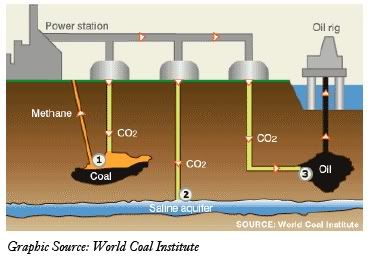
Carbon Capture and Storage (CCS) is a technology that when developed would allow the climate changing emissions from large fossil fuel power plants to be prevented from entering the atmosphere and instead pumped underground into some kind of geological formation.

CCS is controvercial for some technical and some broader reasons. In terms of technology, it is yet to be applied at large scale, as it is also a new technology we have very little information about how securely the co2 would be stored. To complicate things, CCS is being strongly promoted by the fossil fuel industry and scientists have generally been in favour of the technology which, if narrowly viewed seems to be a very positive technology.

There has been a lot written about ccs, most notably by MIT, the IPCC and also, the Wuppertal Institute. The Wuppertal Institute report strikes a far more cautious note than the IPCC or MIT and is well worth a read by CCS enthusiasts (could it dampen that enthusiasm?) and critiques (do you need to improve your argument?).

Labels: ,

Climate Change Action

Home furl google deliciousdel.icio.usnetvouz newsvine diggDigg This!reddit spurl Technorati

Enter your Email


Preview | Powered by FeedBlitz

Tuesday, August 19, 2008

100% renewables in the US in 10 years

Just thinking about rate of renewables roll out and i came across an article mentioning Al Gore's challenge to America. I need to see if there are details behind the proposal because the ability to achieve such a goal--100% renewables in 10 years--would say a lot about the place for CCS in the global energy economy. Namely, there wouldnt be one.

Labels: ,

Climate Change Action

Home furl google deliciousdel.icio.usnetvouz newsvine diggDigg This!reddit spurl Technorati

Enter your Email


Preview | Powered by FeedBlitz

Monday, August 18, 2008

Coal in China: Am i missing something?

I`m looking at coal in China. Perticularly at potential inernational responses and the widely different solution of carbon caputre and storage and a mixed renewables/combined heat and power infrastrucuture. There are many issues but cost and speed are the overriding ones.

What do you think of the plan so far?
http://coalinchina.pbwiki.com/Coal+in+China

I have 3 sections, each with around 5 parts, i have started to break down each of these parts into facts i need to research and i have a series of tables for my references.

As i was emailed my someone at IGES i will also point out that they have published a new white paper as an update on there 2005 work 'asian perspectives on climate change'. I will be reading both the 2005 and 2008 white papers as background for this bit of work i`m doing. IGES are one of the few asian centred energy/climate specialists that i know about...perticularly if we are talking freely accessible work in english.

Labels: , ,

Climate Change Action

Home furl google deliciousdel.icio.usnetvouz newsvine diggDigg This!reddit spurl Technorati

Enter your Email


Preview | Powered by FeedBlitz

New Report on CCS by Environmental Audit Committee

I`m no great fan of the results that the British people get out of there Parliament. However, there are a couple of things that i feel are done very well. One of these is the production of well researched, transparent reports by cross party groups of MP's. The latest report by the Environmental Audit Committe is on Carbon Capture and Storage and it is avialable for free online along with full formal minutes and oral evidence that was used in its construction.

Download Here (PDF)

Labels: ,

Climate Change Action

Home furl google deliciousdel.icio.usnetvouz newsvine diggDigg This!reddit spurl Technorati

Enter your Email


Preview | Powered by FeedBlitz

Wednesday, June 18, 2008

Environmental justice, oil shale, solar, wind, ccs, oil subsidies, independent media.

Just to fill a void in the number of posts recently i thought i`d share a few of the stories that have caught my eye.

Firstly, as i`ve been reading Laura Westra's book about environmental justice and human rights I was interested to read in De Smog Blog that the tiny Arctic village of Kivalina has joined up with some litigators who previously worked on Tabacco and it's link to cancer. The parralles are facinating, and hopeful:


From a legal point of view, it is not enough to prove that burning fossil
fuels is damaging to the environment. They must also demonstrate that Big Oil
conspired to lie about their product to the public. They have a lot to work
with.

For instance, ExxonMobil was specifically implicated by the Union
of Concerned Scientists of funding a Big Tobacco-style PR campaign to
misinform the public on climate science.


While the fossil fuel lobby has been highly successful at delaying meaningful regulation around climate change, they may have over-played their hand. By investing so heavily in distorting public debate around climate change, they have given lawyers like Susman and Berman plenty of potential evidence to drag into the light of day.

In a not unconnected development, Alberta is expecting a rapid ramping up of its oil shale extraction. Many of the effected lands are of disputed soverignty, indigenous groups are not seeing the benefits of these hugely distructive schemes.

In better news, solar is expected to achive grid-connected price parity by 2015! In other words, solar power from pv will cost the same per KWh as electricity from the grid. This isn't the same as having producing power for the same cost as fossil fuels, but it dosent have to be, solar can work without a complex transmission system and such small scale on site uses will make the economics work. Things aren't exactly bleak for the wind industry either; the only real question is how quickly new manufacturing capacity can be brought online. Meanwhile the fossil fuel industry is doing its best to talk up carbon capture and storage.


But weather it's a new renewable energy paradigme that you are after, or an altered version of fossil fuel power sans carbon emissions, one thing that we can surely agree on is the stupidity of the world bank (world development bank?) subsidising old coal power technology.


Fortunately for our fight against climate change, and for broader struggles against corporate power and state complicity there is a growing base of indipendent media. Notably The Real News Network has just teamed up with Celsias to improve coverage of climate change and related issues. That is exciting as i`m a big fan of both these organisations.

Labels: , , , , ,

Climate Change Action

Home furl google deliciousdel.icio.usnetvouz newsvine diggDigg This!reddit spurl Technorati

Enter your Email


Preview | Powered by FeedBlitz

Friday, May 30, 2008

Carbon Capture and Storage: A blogosphere revew.

So what is the general mood out there about carbon capture and storage (ccs) at the moment?

Starting off we Treehugger we have a neutral article on planned ccs test projects by Vattenfall the swedish state owned energy company. De Smog blog is doing what it does best and cronicling the attempts of coal companies to sell ccs as there latest product but this article demonstrates a positive spin from the coal companies nothing more, and some notes of cautious support for the technology from Jeff Scachs of Columbia University. The article also linked to a post which highlights some of George Monbiot's latest work--and not i dont mean attempting to arrest John Bolton for war crimes. Celsias has an extensive and rather negative collection of peices on the technology; the line from Celsias is that this is all a well financed distraction and i`ve got that feeling in my stomach telling me that there may be some truth to that. IPS notes that green groups are devided over the technology, in perticular WWF australia are calling for more funds and more urgency whereas Greenpeace dont want to see any public funds given over to an already proffitable industrial complex of coal producers and consumers. That seems like an honest area for argument; if we persue this what should the incentives be? Treehugger mentions that although current ccs technology uses MEA as the carbon sequestering agent, an active carbon alternative may drop the costs significantly--perhaps from 45 to 30 dollars a tonne of co2. Celsias highlights a major report by greenpeace on ccs that has made waves, as does De Smog Blog. The Independent notes that Shell is supporting the £80 final stage of a canadian CCS experemental plant. The overwhelmingly positive article also has some notes about Nicholas Sterns position and the current EU commitments to the issue. De Smog Blog argues --using the coal industries own language--that ccs aint going to be here soon so we need to get over it. According to Carbonara the UK govornment is asking for applications to build a ccs plant in the UK. Greenormal finds a recent stunt connecting ccs and carbonated water ammusing, this was a very nicely done project, even if i think a tad of target. Treehugger also follows the story. De Smog Blog has what on the face of it is a devestating analysis of ccs from the perspective of timescale, this may be the killer issue. Carbon planet has an interesting post on a us economic analysis of the lieberman warner bill; this includes ccs references and the wider implications of the technology.Terence Berg on DeSmog Blog calls CCS an enduring myth. China Dialogue takes Europe to task for failing to guarentee ccs funding. Saudi Arabia and Norway are working together on ccs, in perticular to get it into the CDM...this is the sort of thing that puts people off ccs and makes others see how politically significant it is. FutureGen in the US was scrapped due to rising prices and then reassembled in a new and, well, different, form. Monbiot writes in China Dialogue about the new coal age in the UK. A broad look at the issues for developing nations in asia is taken in this treehuger post--very interesting to. Stern in China Dialogue on how this is funded. Treehugger on the costs that we all forgot. David Roberts on grist calls CCS a costly alternative to renewables not a transition to them. Treehugger on why ccs wont save us. The guardian takes a closer look.

So the blogosphere seems to be broadly against the technology with some exceptions. This is quite a contrast so some major influential economic and scientific publications. But there is atleast a strong critique of the concept that will make a good starting point for a report; can all the concerns be addressed? If not then things get very interesting, and a hell of a lot simpler!

Labels: ,

Climate Change Action

Home furl google deliciousdel.icio.usnetvouz newsvine diggDigg This!reddit spurl Technorati

Enter your Email


Preview | Powered by FeedBlitz

Thursday, May 29, 2008

Coal In Asia

Hi All, my blog seems to have turned into a cartoon strip, a humorous and relavent cartoon strip, but still....so I thoght i`d post a quick update and let you all know i`m actually working on something. So here are my notes.

When I first heard of carbon capture and storage I was imediately enthusiastic. That enthusiasm was due to my concern about climate change and the appearence of what appeared to be not only a solutin but a solution that could move the coal industry from vicious and powerful enemy to saviour of the climate.

In contrast, many where horrified. They are quite happy with the coal power industry as an enemy, and they want to destroy it. There are several reasons for this including the impacts that coal has on local communities where it is mined. Indeed a recent article on treehugger found that coal power takes up more land than solar over a 25 year period due to the extensive nature of open cast mines.

So we have two very different perspectives, and some people just plain conflicted, on CCS, can they be reconciled, and if not then just what are our options in stopping the roll out of old coal?

I am helping to put together a report to answer these questions, the plan is not settled but will probably look atleast a bit like this.

At the moment i`m sifting related articles for insperation, and looking for reports as a start to the serious reading. Some of these reports are already known to me from previous posts.

I`m also reaching out to green sites to check that this major undertaking is going to have an online audiance. Kevin Granadia for DeSmog blog has just started a new coal website which he has offered a space on once we are done, i contribute from time to time on itsgetting hot in here, i`m going to meet with Chinadialogue about a possible partnership, celsias, treehugger and grist are the obvious green outlets.

Greenpeace has labbeled CCS 'false hope', and many have asked if this isn't just a huge scam, and some are not just critical but down right dismissive. On the other side MIT, the IPCC, Nicholas Stern, the Interacademy Council of Science, and many others have written boradly positive things. However i`m starting to think that even on a technical level there might be better options, reasons for that explained another time.


CCS:
  • IPCC special report on CCS
  • MIT on CCS
  • Greenpeace on CCS as False Hope
  • Stern Review
  • Interacademy Council of Science: Our Enery Future
Exporting our emissions to china:

Energy and Emissions Data:

This report has been reborn in a way from a report i stated to write in late 2006. I found the following reports, of which i will now need the latest versions.

  • IEA "World Energy Outlook 2004"
  • BP "Energy Review 2006"
  • IEA "Key World Energy Stats 2006"
  • WRI "Climate Data: A Sectoral Perspective"
  • WBCSD "Pathways to 2050"

Labels: ,

Climate Change Action

Home furl google deliciousdel.icio.usnetvouz newsvine diggDigg This!reddit spurl Technorati

Enter your Email


Preview | Powered by FeedBlitz

Thursday, February 07, 2008

A Trust Fund Approach to Accelerating Deployment of CCS: Options and Considerations

The Pew Centre for Global Climate Change has just released it's latest report into the deployment of carbon caputure and storage technology. Carbon capture and storage (CCS) is a method for burning coal whilst prevnting the carbon from entering the atmosphere. That atleast is it's technical ability. It does have broader political implications; the coal industry which in the USA provides around half of all electricity, and in China provides around 80%, is a powerful constituency. In a democracy, so the theory goes, people have the power, but i reality concentrations of capital are a rival centre of power often in oposition to the people. CCS has the potential to placate this group, and turn coal production into part of the political solution not a source of fearce opposition. To those who believe that we should take on this fight, i respectuflly disagree and hope that we can do the most important thing in the power sector. Namely, preventing coal plants without carbon capture being built so that we can then focus on the many other problems. I explain the basics of the technology in earlier posts (link bellow) the take home message from the IPCC special report on CCS is that capacity isn't the issue. Saline aquifers, coal beds and depleted oil reserves have ample capacity to use this technology for more than 5o years. The key problems are efficiency loss (some of the coal energy is used to store the fumes), cost (at current levels of development this may be twice that of standard coal) and the related issue of rolling out the technology with sufficient rapidity to make an impact. The use of water for this technolgy may well also be a limiting factor locally.

"This paper discusses one possible avenue to accelerate deployment of carbon dioxide capture and sequestration (CCS) technologies: use of a special-purpose CCS Trust Fund. Trust funds can be an attractive policy option because, if properly designed, they can raise significant amounts of funds from non-governmental sources and can ensure that those paying into the fund benefit from the program. A CCS Trust Fund financed, for example, through fees on coal-based or fossil fuel-based electricity generation may have a role in reducing CO2 emissions from power plants because it could:


  • Raise funds at the scale needed to support a significant number—e.g., 10 to 30—of commercial-scale

  • CCS projects Ensure that the funds raised would be used to demonstrate CCS at commercial scale for a full range of systems applicable to U.S. power plants

  • Establish the true costs, reliability, and operability of power plants with CCS

  • Utilize private-sector business standards for project selection and management to ensure program cost- effectiveness.

  • Significantly reduce CCS costs within 10 to 15 years by supporting approximately 30 demonstrations, yielding substantial national economic benefits as CCS becomes widely deployed. "


Related:
Previous posts and reports from this blog on CCS.

Previous reports in the series.

Labels: , ,

Climate Change Action

Home furl google deliciousdel.icio.usnetvouz newsvine diggDigg This!reddit spurl Technorati

Enter your Email


Preview | Powered by FeedBlitz

Monday, January 07, 2008

Dead End UK : Killing Time instead of Cracking Carbon

Guest post by Jo Abbess
Part of the Climate Change College


Wasting Time on Carbon Capture

Illuminating conversation at a New Year's party this week : I found out that the British Government is killing time over Climate Change, by chasing dead-end technologies.

Instead of concentrating on delivering significant Carbon cuts, the United Kingdom is following up low-value, low-performance options because they can be made attractive to private investment.

In order to fulfill the national commitment of a 60% cut in Carbon Dioxide emissions by 2050 under the Climate Change Bill, thinking clearly in the cold light of dawn brought me to the realisation that there needs to be serious investment in sustainable energy.

Not this tinkering-at-the-edges approach, trying to stimulate business response with flashy toy technologies, untried, untested and unlikely to scale up.

Carbon Capture and Storage is unlikely to deliver anything like the benefits that are being advertised. It may even be a clever way to falsify our national Carbon accounting.

We are genuinely wasting our time with Carbon Capture and Storage - yet the UK Government is committed to spending precious public funds in pursuing it.

Two simple thought experiments explain why it is a non-starter for the prize for big hitters.

Pipeline Litter

The infrastructure argument : it is likely that most of the geological locations suitable for Carbon Dioxide underground storage will be those where Fossil Fuels have been extracted.

So literally, here is what would happen : gas and oil (and coal) are removed from the ground in Location A. They are then transported to Location B to be burned for electrical generation. Then the Carbon Dioxide from Location B is taken back to Location A to be sequestered underground by pumping and capping off (sealing it underground).

Now, this requires considerable built infrastructure to achieve : pipelines, roads, containers, pumping equipment, you name it. And infrastructure requires energy to build it. So Carbon is spent in order to save Carbon.

If Location A and Location B are proximate, things are still not good. If Location B is far from where the electricity is to be used then there will be not only be high inefficiencies in energy distribution, there will also be new infrastructure necessary to deliver that energy : new pylons, transformers, sub-stations and so on.

And besides the infrastructure needed to deliver Carbon Capture and Storage (CCS), there is a further demand. When CCS wells are full, the the CCS plants needs to be re-located.

So a power plant over a Carbon Well would need to be dismantled and re-positioned - all of which requires financial investment, energy investment, labour investment, resource investment and the resulting Carbon Dioxide emissions.

Back of the envelope calculations show that the kind of infrastructure required by CCS would be like that for the oil refinery industry.

It is highly likely that the amount of energy used to sequester Carbon will match the amount of energy delivered by mining and burning the Carbon fuels in the first place.

It will be a no-win situation as the emissions used to sequester will match the emissions sequestered.

Chemical Bounds : It Just Won't Fit Back In The Hole

The second thought experiment requires a basic understanding of chemistry. It doesn't need to be accurate to be valid, so here goes.

Coal is composed mostly of Carbon. When it is burned, it is oxidised, that is, Oxygen from the air is chemically attached to the individual Carbon atoms. Now the size of the resulting gas molecules of Carbon Dioxide is roughly three times larger than the original Carbon.

If the most suitable locations for sequestering Carbon Dioxide are the wells and mines from which the original Carbon was extracted, then after around a third of it has been pumped back down, the well will be full.

Mixed Approach, Good : Skewed Spending, Bad

The Government Departments that handle the management of technologies rightly call for a mixed approach to both energy supply and Carbon Dioxide, but by putting a large number of the available eggs in the CCS basket, they are risking national emissions targets.

Given the pragmatic problems associated with the scaling up and delivery of CCS, it is unlikely that it can reduce overall emissions in a meaningfully significant way.


False Accounting ?

However, it could be that CCS will be used as a Carbon Accounting smokescreen : if we continue to burn barnloads of coal for electricity generation, roughly 50% of the total power supplied, then CCS could be used as a means to cover up the amount of the emissions.

It could be said that the total emissions to air have been reduced because CCS has put the Carbon Dioxide back in the ground.

But this would just cover up the naked and horrible truth that we have been unable to contain and cap our Carbon Dioxide emissions, that we have been unable to progress from the Carbon Economy to the Green Economy.

Protection of Wasteful Practices

CCS is a kind of sticking plaster over a large gaping wound : the Government still expects the United Kingdom to have remote coal-fired power stations, where two thirds of the energy is wasted cooling off the plant, and a further tenth is lost in transmission along the wires.

The thing is : it won't help heal. It's just too small.

Not Listening to Sense

One of the problems that the UK Government continues to have is that it isn't listening to sense : it's easy to dismiss people with a wave of a hand and accuse them of being "environmentalists", that is, "ideologically challenged", when they point out the illogical use of public funds.

Shouldn't we be aiming for actual implementation of new sustainable energy infrastructure (with short lead times to production) rather than running "demonstration" projects for Carbon Capture and Storage, which can't possibly scale up to the size we need and will deliver far too little in terms of emissions reductions ?

Further Reading

Vaclav Smil on Volumes to Sequester

"Canadian energy researcher Vaclav Smil calculates that if just 10% of global CO2 emissions were to be sequestered, this would mean burying annually about 6,000 million cubic metres of compressed CO2 gas. This is larger than the annual volume of oil extracted globally – a bit less than 5,000 million cubic metres in 2005. This means creating an industry that would, every year, force underground a volume of compressed gas larger than the volume of crude oil extracted globally by the petroleum industry. Noting that the oil industry's infrastructure and capacity has been put in place over a century, Smil concludes that 'such a technical feat could not be accomplished within a single generation.'" Reference : SMIL, V. (2006) Energy at the Crossroads: Background notes for a presentation at the Global Science Forum Conference on Scientific Challenges for Energy Research, OECD Conference on Scientific Challenges for Energy Research, Paris, 2006, [Online], Available: [11 December 2006]

FutureGen and other Follies

"There are plenty of experts who still doubt that capturing carbon dioxide and putting it in cold storage will ever work at a meaningful scale. Vaclav Smil at the University of Manitoba has calculated that capturing, compressing and storing just 10 percent of current CO2 emissions — here and now — would require as much pipeline and plant infrastructure as are now used worldwide to extract oil from the ground. And oil is a pricey commodity while carbon dioxide is a waste gas."

The Change College exists to encourage information exchange in the science and education communities about the impacts of Global Environmental Change; to form a circle of experts able to offer research data, opinion and commentary to the media; to promote sound systems thinking for policymakers at all levels of government, social structures and corporate organisations. The Change College is a private, non-profit network, and is cost-free to join.

Labels: ,

Climate Change Action

Home furl google deliciousdel.icio.usnetvouz newsvine diggDigg This!reddit spurl Technorati

Enter your Email


Preview | Powered by FeedBlitz

Thursday, November 29, 2007

Clean Development and Coal : Boosting Health by Fighting Coal

The Worldwatch Institute have just released 'Powering China's Development', a report on Chinas renewable energy status and policy environment.

Here are two issues from the books introduction:
1. Coal and Health as a national emergency
2. Coal as a global emergency.

1. Earlier in the year a world bank report was not released because the Chinese govornment felt it would build social unrest. What did it say? More that 400'000 people a year are dying prematurely due to air pollution. As >70% of Chinas primary energy (c.f. 20% in the US) comes from coal most of these deaths are due to old fossil fool (sic) technology. Clean development is therefore attractive from both local and global perspectives. In cold economic terms, ill health and environmental degredation are placing strain on the economy. It is estimated that just one percent of all Chinese urban dwellers breathe air within EU permissible standards!


2. The Chinese government have many problems in the area of sustainability. In the area of Energy however, things are rather one dimensional. The question is one of coal. How can the exponential growth in coal powered fire plants be limited or the effects ameliorated? First the good news. The Chinese government released a report in June 2007 stating categorically that climate change was a great threat to the nation, and the worlds, development. Perhaps a couple of years ago this wouldn't have happend in the US and China are at the car ownership levels of the US when the Model T Ford was on forecourts! The debate is advanced for the nations state of development. This is reflected by the fact that central government has ordered vast closures of small inefficient coal fired power plants which are being replace with larger more efficient ones: would the US government, or European governments do this?

The bad news is that during 2006 China built 101GW or 101,000MW of power plants (mainly coal). That is more grid capacity than the whole of France! Equivalent to more than two 600MW coal fired power plants per week.

Which leads to my conclusion: we don't have enough wind, solar, biomass capacity in the world to replace this much incremental installed capacity if we wanted to. It cannot go on: we need carbon capture and storage to be rolled out. A global top priority for governments and NGO's must be to make sure that all new coal is CCS enabled and as efficient as possible.

We have a global carbon budget, if China continues building Coal power plants then to meet that budget it will have to decommission them again. This would be an economic nonsense. I can't stress strongly enough how badly the developed nations are failing in allowing this to happen. Funding, technology transfer and a real commitment to anything but coal without CCS must be international priorities and must receive funding commensurate with the global scale of the challenge.

Labels: , , , ,

Climate Change Action

Home furl google deliciousdel.icio.usnetvouz newsvine diggDigg This!reddit spurl Technorati

Enter your Email


Preview | Powered by FeedBlitz