Thursday, August 23, 2012

Another energy bill? The battle is under way.

It seems like only yesterday that the 2011 energy act was established. Well, it wasn't long ago was it. But they are at it again!

New government new energy policy. The Department of Energy and Climate Change have an overview of the work done so far on a new energy bill, it's all being 'worked up' at the moment and thus parliament isnt yet involved although the same cant be said about politics.

The BBC are already reporting on a battle between DECC and their advisers at the Committee on Climate Change and the Treasury. 38 Degrees has already got a campaign going to prevent what they are calling a 'second dash for gas'. The Carbon Brief has done some good work looking into exactly what is going on at DECC in terms of policy on gas power policy.

The Primary Documents:
Some Summaries for those short on time:
Further Background:

Labels: , , , , , , , , ,

Climate Change Action

Home furl google deliciousdel.icio.usnetvouz newsvine diggDigg This!reddit spurl Technorati

Enter your Email


Preview | Powered by FeedBlitz

Monday, August 06, 2012

Coal Plans in Scotland Shelved

A little bit of good news form Scotland. Plans for a new coal power plant at Hunterston have been shelved. This is at least in part due to campainging by Christian Aid and others who have consistently pointed out the difficulty of squaring coal power expansion with Scotlands ambitious climate targets.

Here is a potted history of the struggle to stop Henterston , writtem by the WWF.

Labels: , , ,

Climate Change Action

Home furl google deliciousdel.icio.usnetvouz newsvine diggDigg This!reddit spurl Technorati

Enter your Email


Preview | Powered by FeedBlitz

Tuesday, December 07, 2010

Coal Action Scotland Update

Here's a brief update of what's been going on with Coal Action Scotland and what's coming up. There's a week to go before the Autumn Gathering and lots has been happening!

  1. New THWAC! short film
  2. (Finished so Omitted) THWAC Gathering 6th-10th November
  3. Coal Action Scotland October Newsletter
  4. Action Roundup
  5. Recent News

1. New THWAC! short film

A short film about the Happendon Wood Action Camp and fighting Scottish Coal in the Douglas Valley + Publicising Next Weeks Gathering


4. Omitted

3. October Newsletter

Download and distribute the Coal Action Scotland October Newsletter! Find it here:

front three pages: http://coalaction.org.uk/wp-content/uploads/2010/10/Oct-10-first-three-pages.pdf
back page: http://coalaction.org.uk/wp-content/uploads/2010/10/Oct-10-back-page.pdf

4. Action Round-up

Borehole Drilling Machine sabotaged in solidarity with The Happendon Wood Action Camp

Action against RPS group Glasgow in Solidarity with communities in Co. Mayo and South Lanarkshire

“Nae Coal at Hunterston”: Action against Ayrshire Power and Peel Holdings

CONsultations by Scottish Coal marked by actions against the mines in Douglas Valley

Beginnings of a new wave of direct action in the Douglas Valley against Scottish Coal

5. Recent News

Deadly Coal Tour Visits THWAC

Scottish Coal given a slap on the wrist for environmental damage in Ayrshire

Victory against Scottish Coal in Midlothian!

Labels: , , ,

Climate Change Action

Home furl google deliciousdel.icio.usnetvouz newsvine diggDigg This!reddit spurl Technorati

Enter your Email


Preview | Powered by FeedBlitz

Wednesday, March 24, 2010

Note on CCS Policy

There are limits to what you can say in 140 charachters so here is a quick note on my thougts about CCS. I`m not an expert but it is a topic that i have been looking at for some time.

I started out enthusiastic about CCS and annoyed with environmentalists who where against the technology. My positions was due to my concern about the development of China and India and the potential for shifting these economies over to renewable forms of power(1).

However, after reading a superb report (2) by the Wuppertal institute i started to question both the merrits of ccs and the promise when compared to alternatives. The big point that comes out of this report is that when you consider total carbon emissions from coal rather than just the percentage of emissions that you can capture from the coal you end up with carbon reduction of around 65% rather than 90% when we look purely at direct coal emissions.

It is also worrying to me that by simply swapping coal for coal + ccs will give you a more pollouting plant in terms of local air quality. Given the air quality in asia i do have some feeling about the morality of promoting a very expensive and more pollouting form of power that has the sole advantage of reducing carbon emissions.

I realise that there is some interest in these technologies within Russia, hopefully more than in asia. I don't have references to hand but i did some reading on political/technical/scientific opinions in China about CCS and the attitude was one of extreme skepticism. Let me know if you want the paper.

These are my concerns about CCS. With limited govornment budgets i do think that offshore renewables should be a priority for the UK. So i do have some concerns about expenditure on CCS displacing expenditure on what i think deserve to be national priorities exploiting our natural advantage.

If money is to be expended on CCS technologies then i would not disagree with this so long as the warnings of the Environmental Audit Committee are taken seriously:
'“The possibility of ccs should not be used as a fig leaf to give unabated coal-fired power plants an appearance of environmental acceptability” .

In order for CCS to be seen as anthing other than an expensive and distracting measure, it will have to be tested on entirel ccs plants, not 20% CCS plants. Indeed, we alread have plenty of old coal plants to test post-combustion technology on.


REF:

(1)
My initial view that CCS isn't nessicary for UK electricity supplies and is more usefully considered an export technology is unchanged. We have a vast offshore wind resource, soon to be quantified more acurately by Boston Consulting Group. The key question is one of transmission: r&d and investment in infrastructure would be an alternative to investing in CCS which is VERY expensive.

(2)
The Wuppertal institue report is so notable because it looks not only at emissions per net unit of energy produced, but also at transport, mining and processing emissions.
http://www.wupperinst.org/en/projects/proj/index.html?projekt_id=25&bid=155

(3)

http://www.parliament.uk/parliamentary_committees/environmental_audit_committee/eac_220708.cfm

Labels: ,

Climate Change Action

Home furl google deliciousdel.icio.usnetvouz newsvine diggDigg This!reddit spurl Technorati

Enter your Email


Preview | Powered by FeedBlitz

Monday, March 22, 2010

2nd UK Coal Mine Occupation in Two Weeks


A press release sent ouy by activists occupying Blair House Open Cast Coal Site says that the latest occupation started last night:

"Last night twenty five activists occupied the site of the Blair House OpenCast
Coal Site in solidarity with near-by communities and in directintervention of
the environmental destruction that it will cause."

The other recent site of occupation is the Defend Huntington Lane camp (twitter) in shropshire. Both of these occupations come around two months after the eviction of Mainshill Solidarity Camp in South Lanarkshire.

One of the interesting aspects of the press release sent out by activists is their sympathy for local councillors who despite local opposition dare not refuse planning permission for the mine:

"The Council, in their defence, wouldn't dare refuse another open cast
coal mine application after their refusal of ATH Resources mine at Muir
Dean on the insistence of Crossgates residents, was overturned by the
government and cost them financially."

A similar situation occoured in my temporary home of Brentford west London where an unpopular development was opposed by many in the council but where the legal costs of refusing planning and loosing on appeal prevented the council from acting in the interests of the local population.

Campaigners use 3 main arguments against the mine:

  • Impacts on local people.
  • Impacts on the local environment.
  • Impacts on climate change and meeting our carbon emissions reduction targets.
Campaign website: Black Wood Solidarity Camp
Press Contact: 07806926040

Related:
  • Article about the occupation: STV.

Labels: ,

Climate Change Action

Home furl google deliciousdel.icio.usnetvouz newsvine diggDigg This!reddit spurl Technorati

Enter your Email


Preview | Powered by FeedBlitz

Sunday, March 14, 2010

Stopping Coal Power in The UK : How's it going?

An update on coal power in the UK:
  1. Coal power without ccs would have been ruled out if Labour rebels, Lib Dems and Torries had sucesfully passed an emissions performance standard. The EPS fell six votes short.
  2. Hunterston energy plant is planed to have some CCS Ayrshire Power, owned by Peel Energy Ltd. Planning permission is likely to be submitted to the scottish govornment shortly. This 1600MW power plant is likely to have 300MW of CCS. Some don't believe that a 80% dirty power plant is clean enough.
  3. EON (Kingsnorth) and Scottish Power (Longgannet) won a joint award for basic CCS preperation and study. One will win funding.
  4. E.ON is looking for companies to carry out environmental assesment of a project to pipe co2 across Kent and into the north sea.
  5. The infrastructure clearance work has begun at Huntington Lane Opencast Mine site in Telford, acres of mature, and immature trees have already been felled ready for constructing the haul road to link the two sites together.
  6. E.ONs' Kigsnorth plant was put off for at least 3 years earlier in the year.

The most important piece of news is that the EPS failed and that plans for largely unimitigated coal plants, most immediately Hunterston, are now to be introduced into the planning system.

Stay up to date with coal in the UK

Labels: ,

Climate Change Action

Home furl google deliciousdel.icio.usnetvouz newsvine diggDigg This!reddit spurl Technorati

Enter your Email


Preview | Powered by FeedBlitz

Thursday, August 06, 2009

Coal Mine Sabotage in Scotland

The Camp for Climate Action Scotland has been tipped off that anonymous activists have successfully sabotaged the Glentaggart opencast coal mine in South Lanarkshire. The unknown individuals have disabled the conveyor belt that moves coal from the mine to Ravenstruther rail terminal where the coal is then sent to Drax power station in Yorkshire.

The sabotage has the potential to greatly disrupt the removal of coal. Insiders say that once it has been stopped it is difficult to restart the heavily laden conveyors which is several kilometers long and comes in quarter kilometer sections. Drax powerstation was the site of the first Camp for Climate Action 2006.

The Camp for Climate Action Scotland is taking place cross the valley from Glentaggart at the site of another proposed open cast mine at Mainshill woods near Douglas. A protest camp has already been in place for six weeks campaigning against the plans which have gone through despite strong local opposition. The area is already one of the most heavily mined areas in Europe with a number of other opencast mines already being worked.

Diarmaid Lynch, a spokesperson from the Camp said on hearing the news
"“Fantastic. Congratulations to those who did this. Opencast mining is responsible for a spike in the number of lung related deaths in this small area. It is time that the likes of Scottish Coal and the planning authorities are held directly responsible for their role in these deaths. Climate change is a killer, both at home and in the Global South where those who have benefited the least from industrialisation are the first to pay the price.”"

The World Health Organisation estimates that climate change kills 150,000 people a year and that figure is expected to grow as countries fail to take action. Cancer in the Douglas postcode area is 23% above the national average, and 28% above the regional average. In the four years that the existing three opencast mines have been operating in the area pulmonary issues have increased 60%.

In a separate development the Camp for Climate Action has also learned that police leave across the central belt of Scotland has been cancelled as the various forces move to a state of high alert. To date the policing at the Camp has been very low key, but campers remain alert.

---end-


1. The Camp for Climate Action Scotland can be contacted on 07910 915 698, 07906 499 379 and 07722 708 760. For further information on the camp see www.climatecampscotland.org.uk

2. The aims of the Camp for Climate Action Scotland are to highlight practical solutions to climate change from a grassroots level through education and demonstration of sustainable living, and to take direct action against the root causes of climate change. It among the first of many such camps taking place this year. Previously camps have taken place at Drax Powerstation, Heathrow and Kingsnorth Powerstation in the UK.

Labels: , , ,

Climate Change Action

Home furl google deliciousdel.icio.usnetvouz newsvine diggDigg This!reddit spurl Technorati

Enter your Email


Preview | Powered by FeedBlitz

Tuesday, August 04, 2009

Climate Camp Scotland is Underway!


Yes, the Camp for Climate Action in Scotland is up and running, and needs you to come as soon as you can!

We said that the camp would be somewhere in the Firth of Forth, but the recent occupation of a soon-to-be open cast coal site by the Mainshill Solidarity Camp has provided us with a beautiful site that is in need of support and solidarity from movements such as this one.

There is no shortage of targets in this area, we are surrounded by open cast coal mines and other infrastructure and within easy reach of targets across the central belt of Scotland.

At the moment Climate Camp is busy with people building compost loos, grey water systems, cooking food and getting to know the local community.

We need your help to defend the trees and stop this site being turned into an open cast coal mine and contributing to climate change!

How to get to the camp:


See you there!

Climate Camp Scotland.

Labels: , , ,

Climate Change Action

Home furl google deliciousdel.icio.usnetvouz newsvine diggDigg This!reddit spurl Technorati

Enter your Email


Preview | Powered by FeedBlitz

Monday, June 22, 2009

Coal Resistance Continues at Mainshill Solidarity Camp

It's another interesting week of resistance to coal power. While Greenpeace occupy a boat bringing coal into Kingsnorth, a group of anti-coal activists have setup an ocupation at a site where Scottish Coal are planning to start a new mine.

Here is a update from the site.

After a whole night of digging in and strengthening defences, the rumoured eviction this morning hasn't happened. However, the solidarity shown by the number of people who joined us over the weekend has been fantastic and allowed huge amounts of building work to happen, making the site well defendable.

Instead of police or court bailiffs, a van-load of Apex workers tried to gain access to the site to continue bore-hole work on the site, vital to the coal mining operation. Bore-holing and clear-felling had been happening before the site was occupied, and since the occupation no work has been carried out. It is thought that this work is illegal as Scottish Coal have to carry out an extensive wildlife survey before felling any trees or starting work as a condition imposed by the council.

Access to the site and Apex machinery was blocked with a vehicle, and Apex workers responded by threatening to smash the windscreen if it was not removed from in front of the gate. Very quickly, the people inside the vehicle were joined by campers and car loads of locals who came out in support and to avert an eviction. The Apex workers backed down after this show of strength!

In a plea of solidarity to contract workers carrying out the bore-hole drilling and clear-felling, they have been asked to side with the community and camp against their bosses and refuse to carry out work on the site.

The Chief Inspector for the area has stated that the police have no intention of removing the camp at present, but will let us know if that changes. It is thought that a court order is being sought to evict the camp.

Lord Home, the land owner, Scottish Coal, the mining company, and Scottish Ministers can stop this project – if they were to come down and see the level of support and involvement in the camp from the local community they would see how strong the opposition is to this mine. If they don't decide to overturn the decision, they will have a very expensive eviction on their hands.

Your solidarity is still needed! We can stop this coal mine from going ahead, both by defending the site and working with the local communities to take back decision-making power and get permission overturned. Please join us as soon as you can – see the website for details.


Mainshill Solidarity Camp (WEB)

Labels: , , ,

Climate Change Action

Home furl google deliciousdel.icio.usnetvouz newsvine diggDigg This!reddit spurl Technorati

Enter your Email


Preview | Powered by FeedBlitz

Greenpeace blocks delivery of coal to Kingsnorth

Greenpeace board a coal freight ship on it's way to make it's delivery at Kingsnorth. EON's coal plant at Kingsnorth is the focus of campaigns by numerous organisations due to the govornments indication that a new coal plant could be built there as a replacement--the first new uk coal plant in 30 years. Govornment policy has shifted somewhat, no new and entirely unabated coal plants are going to be allowed in the UK but a coal plant with a quater of its' carbon emissions captured as is currently proposed is a long way from the plans of a sane govornment. If the govornment are keen on CCS then why dont they trial it rather than adding a token ammount of ccs to a vast polluting coal plnt which in all likelyhood will be around for 40 years?

Labels: , ,

Climate Change Action

Home furl google deliciousdel.icio.usnetvouz newsvine diggDigg This!reddit spurl Technorati

Enter your Email


Preview | Powered by FeedBlitz

Friday, June 05, 2009

BAM offices invaded in protest over kingsnorth.

The headquaters of BAM have been targeted by a group of protestors complaining of it's plans to help build a new coal plant at Kingsnorth while marketing itself a "sustainable construction company".

The protestors are part of the Climate Camp movement and in particular the E.ON F.OFF campaign. E.ON are planning to build the first new coal plant in the UK for over 30 years.

“BAM Nuttall say they need this work because of the recession, but this completely misses the point. If we keep burning coal, then we’ll lose a lot more than just our jobs – people’s homes, health, food supply, and the stability of our society are all at risk from climate change. Instead, we need to build a sustainable society, powered by renewable energy from the wind, sun and tides, which will lead to better ways to live and work. We need to make sure that this transition is a fair one, actively involving workers from the energy industry. We’re hoping to have some interesting conversations with BAM staff today about all of these issues!”


Coverage:

Labels: , ,

Climate Change Action

Home furl google deliciousdel.icio.usnetvouz newsvine diggDigg This!reddit spurl Technorati

Enter your Email


Preview | Powered by FeedBlitz

Wednesday, June 03, 2009

Remember , Remember the 5th of December

Labels: , ,

Climate Change Action

Home furl google deliciousdel.icio.usnetvouz newsvine diggDigg This!reddit spurl Technorati

Enter your Email


Preview | Powered by FeedBlitz

June 1st Climate Rush: No New Coal, Trains not Planes

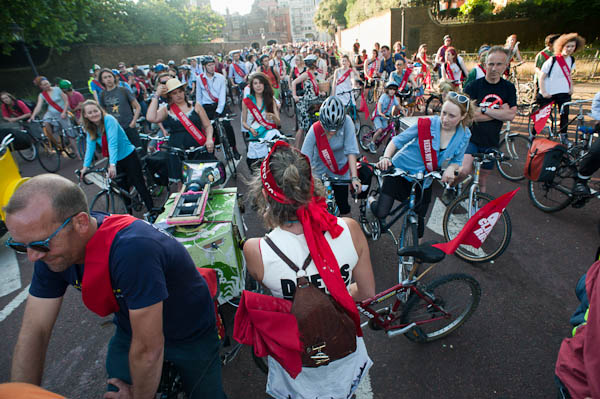
Several hundred climate change activists took part in a Pedal Power Bike Rush organised by the 'Climate Rush' around London yesterday evening (Monday 1 June 2009) demanding the UK government take effective action to counter climate change.


Related:
More on climate rush:

Labels: , ,

Climate Change Action

Home furl google deliciousdel.icio.usnetvouz newsvine diggDigg This!reddit spurl Technorati

Enter your Email


Preview | Powered by FeedBlitz

Sunday, May 31, 2009

Kingsnorth Six

When six activists, protesting against climate pollution, scaled a tower at a coal-fired power station in 2007 the resulting court case drew support from the world's leading scientists. Their subsequent acquittal proved historic and changed government policy. Here, the 'Kingsnorth Six' tell their story

* Geraldine Bedell
* The Observer, Sunday 31 May 2009

Six ordinary people. One extraordinary feat of courage and endurance. Twenty thousand tonnes of carbon dioxide belched into the atmosphere in a single day. Twelve members of a jury, reaching a verdict that could change the future of the planet. From these ingredients, Nick Broomfield has fashioned a film that tells the gripping and (the description is unusually literal) life-changing story of the Kingsnorth Six.

When a demonstration at the Kingsnorth power station in north-east Kent in late 2007 led to the arrest of six climate change activists, what had until then seemed a rather dry local planning issue exploded into a story of national and international concern. The verdict at their trial turned out to have far-reaching implications for activism, the future of coal, even the planet.

Now a 20-minute film, A Time Comes, by the much-admired documentary -maker Nick Broomfield, cuts police and Greenpeace footage of the occupation together with news clips and interviews with the activists. What emerges is how ordinary the Kingsnorth Six are - they could be the bloke next door or the woman across the office - but also how brave and tenacious. The film is released just as the government's review of its coal policy is expected and campaigners hope and expect the review will define a seismic shift in official attitudes to carbon emissions.

"I was attracted to making a film about the Kingsnorth Six because they're such everyday people," Broomfield says. "You tend to think of environmental activists as super-fit professionals, but they are modest and understated. I admire the way they were prepared to see it through - to take action for what they believed and take the consequences - and I wanted to make the film immediate, personal, anecdotal.

"I loved the footage of them struggling up a chimney as if in Dante's Inferno. Their story is just a very human one of great courage and great love and belief, which is, I suppose, what all great stories are about."

It is a story that began in October 2007 when a coal-fired power station at the mouth of the river Medway was nearing the end of its natural life. E.On, the German company that owns and operates it, had applied the previous year for planning permission to build a replacement on the site. This would be the first new coal-fired power station in Britain for 30 years, but a string of similar applications was lined up behind. If Kingsnorth went ahead, it was reasonable to assume coal-fired power stations would be built across the country. The government gave every indication it was intending to give permission, though it is widely acknowledged that coal is the single greatest threat to the climate, responsible for about half the fossil fuel carbon dioxide emissions in the atmosphere. The average Briton emits 11 tonnes of carbon a year; it would take this one hypothetical Brit 1,800 years to emit the equivalent of a day's emissions at Kingsnorth.

So, at 5am on the morning of 8 October, protesters waving placards jostled noisily at the front gates of the power station. While the plant's security guards were distracted, another group of about 30 activists made its way quietly along the sea defences at the rear, cut a padlock and sneaked onto the site. "A security truck with a couple of guys tore up," says Ben Stewart, who was there. "We said we were Greenpeace and we had to shut down the power station because of climate change. They said, 'Good luck. Do it safely.'"

Once inside, the activists scattered in the darkness - some to the pump house, 18 to occupy the conveyor belts that carry the coal to the furnace, five to the chimney that towers 220 metres above the hulking mass of the power station. This last group walked inside, closed a metal roller-door behind them and cut the electricity. Two of them - Stewart and Huw Williams, an experienced caver - had been up the inside of a tower at Didcot power station and they expected to find a similar spiral staircase here. Instead, there was a metal ladder fixed to a wall. The wall and the ladder were almost the height of Canary Wharf.

The five were each carrying 50kg bags holding their supplies, which included climbing ropes, paint, food (pasta, pesto, tinned tomatoes, bread, water, coffee, and a cafetiere - "No instant shit for us," Stewart says) and they'd estimated beforehand that it would take them two-and-a-half hours to reach the top. Without a staircase, it was to take them nine.

"It was the most physically exhausting thing I have ever done," Stewart recalls. 'We were climbing up between the four flues. The CO2 goes up at a temperature of 120 degrees and it was like climbing through a huge radiator - the hottest, dirtiest place you could imagine."

The ladder had a "back-scratcher" - a rudimentary metal cage designed to prevent falls - which meant the space was too narrow for their bags. They had to pull up their kit on ropes, using their body weight to haul them between the five platforms. "Imagine the most tired and in pain you've ever been in and multiply that by a million," says Will Rose, a press photographer, who shot much of the footage Broomfield used in his film.

"We hadn't slept much the night before because we were nervous and in a strange place with a lot of other activists, and after a few hours of climbing, any adrenaline had worn off and we were dehydrated and exhausted. I felt as though I was going to collapse. My arms were aching from pulling on the ropes and my legs were aching from taking the strain. You'd get to a platform and rest for a minute and then have to pull up the bags. You can't stop because you can't let down the rest of the team."


The smokestack was filthy. They had coal dust in their mouths, up their noses. They had to scrape it off like tar. After hours of struggle - "I'm told it was nine but it felt like 12," Stewart says, "a dusty, dark, carcinogenic, hot, horrible experience for hours and hours and hours" - they saw light at the top. They were running at least six hours late. They rested briefly to recover some strength, aware that if they stopped for too long it would get dark. Williams rigged up ropes. Emily Hall, who works for Greenpeace in logistics, mixed paint. Rose shot photographs and film. Stewart spoke to the outside world, including his parents. "You might see me on the news on top of a power station chimney," he warned them. "They said, 'Are you sure that's wise?'"

At 6pm, Kevin Drake, an experienced climber and freelance industrial rope access safety supervisor, went over the side of the smokestack with Hall, who had only been climbing a couple of years, "sporadically". Rose's footage, if you are at all anxious about heights, is sickening: a vertiginous drop down a brick tower, Drake and Hall dangling, tiny figures in dizzying mid-air in the growing gloom.

"It was OK going over," Hall says. "I'd been asked to do it two weeks before so I'd had time to prepare myself mentally. It was later on that it didn't feel so nice, when it was getting dark and starting to rain. I could see the people on the conveyor belts being led away by the police below and that was disheartening. The ropes were really heavy, because they had to be so long, plus we were carrying paint on our backs. Our muscles were already sore from the climb."

It is hard to imagine any of them being in trouble with the law under any other circumstances and for Rose, too, the numbers of police were alarming. "It was cold and windy up there, but the thing that scared me most was the police helicopter that was circling us and the police vans below, with all these little black dots. I've got a huge amount of respect for the police, but it was alarming to think that sooner or later we'd have to come down and face them."

The plan was for Drake and Hall to paint "Gordon Bin It" down the side of the chimney. Drake's main worry was that he was "a bit dyslexic" and may make a spelling mistake. They judged the letter size with a length of knotted rope and from a distance the paint job looks surprisingly professional. "It didn't look so good from close up," Hall says.

They only managed to get as far as "Gordon". By 8pm, the light was failing and they were worried about the climb back up. Tim Hewke, who was co-ordinating from a van on the ground and would eventually be arrested and charged as the sixth member of the team, radioed, urging them to return to the top.

For Hall, getting back up the chimney "was the hardest thing I've ever done. It was a really hard slog, pulling on a rope, and my muscles were exhausted from pulling on ropes all day. I was emotionally drained. My hands were raw from climbing the metal ladder. But Kevin stayed with me. I swore a lot and he whistled and sang a bit and told me I was fine. I knew they were cooking pasta at the top, and I was going to Paris on holiday in a couple of weeks, so I kept repeating to myself, 'Pasta, Paris. Pasta, Paris.' And I knew that not making it wasn't an option".

The pasta and pesto was, by general agreement, one of the best meals anyone had ever eaten. Drake and Hall had intended to go back over the edge the following morning to complete their sign writing, but it turned out that the police in the helicopter, who had been shouting something inaudible at them through a megaphone, were warning that E.On had obtained a high court injunction. They would have to come down.

They decided they were too exhausted to get back safely that night, so they went inside the chimney and slept in the heat and coal dust until 6am. After a breakfast of tinned tomatoes, bread and coffee, they packed up and started back. "It felt OK to come down then," Stewart says. "We felt we'd done something important."

Emerging from the chimney, Hall "felt really proud. So many people had been involved, there had been so much planning and investment, and it was great to be part of it. There was an amazing sense of fulfilment".

The five activists emerged at around 1pm. The police - very pleasant, they all make a point of saying - took them away to their vans, swabbed them for DNA and fingerprinted them. Eventually, they took them to Gillingham police station. "I had to shower naked in front of two policemen," Rose says, "but it was so amazing having a shower, I didn't really care."

All the protesters who had been occupying the conveyor belts had also been arrested. They were charged with aggravated trespass; the six learned that they would also face charges of criminal damage. Hall and Williams were released "by a fluke" that evening with the conveyor belt team. The other four were held in custody for 24 hours.

They had discussed beforehand the possible consequences of the action. "It was unlikely we'd be let off with a parking ticket," Stewart says. Even so, they were surprised by the extent of the criminal damage - £30,000 - said to be the cost of cleaning the tower. "We left absolutely nothing up there," Hall says, "and all they did to clean it up was to paint white boxes over our lettering."

Perhaps, though, they weren't entirely dismayed. Any criminal damage charge for more than £5,000 has to be tried by a jury. "My first thought was, 'I'm going to go to jail,'" Stewart says. "My second was, 'But I'm going to get a jury trial.'" It would be an opportunity to put the climate change case in public.

The months of waiting for the court case were difficult. Criminal damage cases involving similar sums had resulted in prison sentences. "Some days, I felt we'd done the right thing and people would see that and we'd be absolutely fine," Rose says. "On other days, I'd think, 'Oh my God, I'm going to prison for this.' You can see what I look like. I wouldn't last five minutes in prison."

The eminent barrister hired to defend them, Keir Starmer, was made director of public prosecutions a month before the trial, leaving them without a lawyer. Michael Wolkind QC stepped in. "We had a meeting with him," Stewart says, "and asked who else he'd represented. He said, 'The nail bomber, Tony Martin and the 7/7 bombers.' We said, 'Have you ever represented anyone who's not a fascist? And have you ever won a case?'"

The trial opened at Maidstone Crown Court (in Ann Widdecombe's constituency, perhaps not the first place a climate change activist would choose) on 1 September 2008. "Michael Wolkind prepared really diligently," Stewart says, "but his first line to the jury was, 'They care about Tuvalu. Do you too?' And I thought, 'That's it, I'm going down.'"

The standard defence against criminal damage is that by committing the crime, the defendant prevents damage to more valuable property - so it's acceptable to kick down the door of a burning house if you thereby prevent its complete destruction. The argument Wolkind and his team had to make was that shutting down Kingsnorth for 24 hours was a significant contribution to retarding carbon emissions, preventing the worse harm of climate change. They also had to establish that there had been no legal options.

To everyone's surprise, one of the world's leading climate change scientists, Professor James Hansen, responded to an email from Joss Garman, Greenpeace's coal campaigner, by saying he would testify on behalf of the Six. Hansen, whom Garman describes as "a rock star of climate change", has been director of the Nasa Goddard Institute for Space Studies for the past 20 years, an adviser to US presidents, and was the first person to testify to Congress on the seriousness of climate change. While in the UK, he met the prime minister and the foreign secretary, because that is the kind of person he is, but his reason for coming was to testify in a small courtroom in Kent. The nub of his argument was that every tonne of carbon counts, so that while it may not be possible to pinpoint the extinction of one species to a particular molecule of carbon, it is reasonable to assert that Kingsnorth alone would lead to the extinction of 400 species over its lifetime.

Both Geoff Meaden, professor of geography at Canterbury Christ Church University, and Hansen produced maps showing the impact of rising sea levels on the Kent coastline, the world's leading climate scientist giving a private seminar to the jury about the future of their area. Inuit leader Aqqaluk Lynge described the melting of polar ice and its impact on Inuit homes and food supplies.

Gordon Brown had just changed his mind about an autumn election; Zac Goldsmith argued that this had closed the normal democratic channels, especially given that it had recently been estimated that the world was a mere 100 months away from a climate tipping point. Jennifer Morgan, a former adviser to Tony Blair and an expert on international climate negotiations, said the G8 had failed to deliver significant progress in preventing catastrophic change.

The defence's arguments were given a boost by the 2006 Stern review for the British government, which put a price on climate change for the first time, calculating that each tonne of carbon causes $85 worth of damage. This means that shutting down Kingsnorth for one day may have prevented around £1m of damage.

Each of the defendants had prevented 3,300 tonnes of carbon from entering the atmosphere (their share of a normal Kingsnorth day's output). It would have taken them 300 years of zero-carbon living apiece to have had an equivalent impact.

They all had to give evidence. "It was petrifying," Stewart says. "I kept thinking if I buggered it up I'd be letting down my fellow defendants and ruining the chances of making this important statement. As the case went on and the evidence piled up, and it was such a compelling story, so emotional, I began to think we might get three of the jury not to convict - which, of course, would get us off. I started to think we might even get five."

The jury was discharged at 10am on Tuesday 9 September. They did not return their verdict that day and it was difficult for the Six to sleep that night. "I managed to get through the trial fairly well, to hold my composure," Rose says. "Then about an hour before the verdict on Wednesday, I almost had a blackout. I was shaking, my heart was racing, my breath was short. I kept going back over everything, all the evidence. It was like seeing your life before you die."

"So much depended on that first utterance - 'N' for not guilty or 'G' for guilty," Stewart says. "As soon as the foreman went 'N', the court erupted." His mother, in the public gallery, burst into tears. So did Hall. There was elation in the Greenpeace offices, where everyone was gathered round director John Sauven's phone, waiting for Stewart's text; and in New Zealand, where Hall is from; in the Northumbrian coal mining village where Rose grew up; and especially among all the other activists who had been at Kingsnorth.

That night, the 10 o'clock news reported that a government decision on the future of Kingsnorth had been postponed. That this was a U-turn is not in doubt. E.On had already gone out to tender for construction of the new plant. Exchanges between the company and the civil servants in the Department of Business, Enterprise and Regulatory Reform (BERR), obtained by Greenpeace under Freedom of Information legislation, prove that the government had been drawing up conditions for approval of Kingsnorth and was prepared to be conciliatory about how far these related to climate change.

Within a month of the verdict, business secretary John Hutton was reshuffled and responsibility for energy moved from BERR to the new Department of Energy and Climate Change (DECC), which put energy where it belongs, not with business, but with the environment. The new secretary of state was Ed Miliband who, with David Miliband and Hilary Benn, had previously opposed a new Kingsnorth in cabinet.

The government's previous position had been that the new plant would have to be "carbon capture and storage [CCS]-ready". In other words, whenever technology to capture and bury carbon emissions became feasible, Kingsnorth must be able to plug it in. For Greenpeace, this was meaningless - "It's like saying my garage is Ferrari-ready," Stewart says. CCS technology does exist, but has never been tried at scale. It may not work. It certainly may not be financially viable for a huge power plant.

The new policy, as articulated by Ed Miliband in April, complete with a neat soundbite - "The era of new unabated coal has come to an end" - is that no new coal-fired power station will be allowed unless it captures the carbon from 400 megawatts straight away. In the case of Kingsnorth, this would represent about a quarter of its output. And by 2025, Kingsnorth would have to have CCS technology for its entire output.

Many questions remain to be answered. The power companies are now lobbying fiercely, arguing that it makes no sense for them to build power plants that could be inoperable after 2025 if the technology doesn't work or proves to be unaffordable. They have the support of some of the civil servants who moved across from BERR and some members of the cabinet. Greenpeace, meanwhile, doesn't want to see a new plant that guarantees only that a quarter of emissions will be captured; it would rather the CCS experiment was tried on an existing plant.

Results of a consultation on a new coal policy are due from DECC imminently. Miliband will have to decide whether CCS is a promising enough technology to justify public investment and, if so, what form it will take. Carbon can be captured before combustion, which is a cleaner method, or after, which has the advantage that the technology can be fitted to existing power stations and potentially sold abroad.

Greenpeace's position is that there should be limits on carbon emissions for all power stations (which it would set currently at 350g of CO2 per kilowatt-hour of electricity generated and reduce in time as the technology develops). While CCS, certainly pre-combustion, would meet that proposed standard, the technology is not proven and Greenpeace would prefer to rely on renewables.

These are highly technical questions. What is clear, even to those of us who are clueless about the science of carbon capture or unqualified to judge whether the energy gap can be bridged without coal, is that Kingsnorth is now unlikely to go ahead without offering some hope for climate change. The publicity generated at the plant in October 2007 and the subsequent verdict has almost certainly (as long as Miliband doesn't crack) paved the way to a more thoughtful energy policy which has climate change at its heart rather than as bolt-on, entirely dispensable rhetoric.

In this, the bravery of the Kingsnorth Six was vital. What they have shown is that direct action can be a legitimate form of political action. Properly carried out, it can muster public support and change people's minds. It can even shift government policy. In years to come, we may have cause to thank these sympathetic, courageous and ordinary individuals. It's not a bad result from a day and night up a dirty chimney. They all think now that the climb was worth it.

Power to the people

They came, they climbed, they conquered

December 2006
German company E.On applies for planning permission to replace the existing plant at Kingsnorth in Kent with the first new coal-fired station in Britain for 30 years. The plant would produce an estimated 19,800 tonnes of carbon dioxide emissions every day.

October 2007
Environmental activists hold a demonstration at Kingsnorth. Around 30 get on site and shut down the plant; five scale the inside of the towers and paint a giant message on the outside. All are arrested. The five who scaled the tower and the activist who coordinated the ascent from the ground are charged with causing criminal damage of £30,000.

January 2008
Medway council votes to allow building to go ahead at Kingsnorth but recommends a public inquiry.

April
The Royal Society criticises the government policy on coal, saying that any new coal-fired power stations unable to capture and bury 90% of its carbon emissions by 2020 s hould be closed.

June
The head of the government's sustainable development commission, Sir Jonathon Porritt, tells the secretary of state that a new generation of coal plants would "destroy the overall credibility of the government's climate change programme".

August
Environmental activists hold a climate camp outside Kingsnorth for 10 days. Hundreds are arrested while taking direct action against the plant.

September
The trial of the Kingsnorth Six - those involved in the scaling of the tower - takes place. Professor James Hansen, director of the Nasa Goddard Institute for Space Studies and the first person to testify to Congress about the threat of climate change, gives evidence on their behalf. All are acquitted.

December
The committee on climate change finds that coal stations should be expected to capture and bury all of their carbon emissions by the early 2020s.

April 2009
Ed Miliband, secretary of state for the newly created Department of Energy and Climate Change, announces a change of policy on coal, ruling out unabated coal stations.
Ally Carnwath

The Kingsnorth Six
Kevin Drake
Kevin Drake, 44, lives in a Wiltshire village with his wife and daughter. He works as a rope access safety supervisor and loves the outdoor life, including caving, camping, rock climbing and body boarding. He has been volunteering for Greenpeace for 10 years.

Huw Williams
Williams, 41, is a former shepherd and sign writer from Northamptonshire, and is a keen caver, touring cyclist and narrowboat owner. He has been volunteering with Greenpeace for 15 years and his interests include rural crafts and wildlife watching. He is now cycling to Namibia with his partner and is somewhere outside Tangier.
Emily Hall
Born in Hawkes Bay, New Zealand, Hall left home to travel in 1996. She lives in London, works for Greenpeace in logistics and learnt to climb in order to get more involved in direct action. "My mum was incredibly worried throughout the trial. I rang to tell her the verdict straight away. I also rang my boyfriend, who was relieved because he had been worried that he'd have to bust me out of jail."

Tim Hewke
Tim Hewke co-ordinated the Kingsnorth action from the ground. He is in his 40s and has worked for Greenpeace for 13 years as a researcher. He lives in Harrietsham, Kent, and likes "wining and dining, photography and growing vegetables - and recently won the prize for the tallest sunflower in Chegworth.

Ben Stewart
Stewart, 35, is a law graduate from Lyminge, near Canterbury. He is head of media at Greenpeace UK, and a former Guardian Young Journalist of the Year for an interview he conducted with Michael Howard. The then-home secretary lost his temper and threw Stewart out of his office after a question about the Criminal Justice Bill. He has met Bill Clinton, Tony Blair and Gordon Brown to discuss green issues.

Will Rose
Rose, 29, grew up in Ashington, Northumberland. "The town was completely supported by coal. My grandfathers worked down the pits and my father was an engineer in the industry. It was a big thing for me to find out that coal was a bad thing." A press photographer, he now lives in London and works for Greenpeace and other NGOs: "I wanted to use my skills for something I believe in."

Related:

Labels: , , , , , ,

Climate Change Action

Home furl google deliciousdel.icio.usnetvouz newsvine diggDigg This!reddit spurl Technorati

Enter your Email


Preview | Powered by FeedBlitz

Tuesday, May 26, 2009

UK Climate Policy?

Things are getting tough for Ed Miliband. It looks like fudging the issues isn't the same as providing leadership.

Labels: , , , , ,

Climate Change Action

Home furl google deliciousdel.icio.usnetvouz newsvine diggDigg This!reddit spurl Technorati

Enter your Email


Preview | Powered by FeedBlitz

Wednesday, May 13, 2009

Christian Ecology Link Update: AGM, Dirty Coal, Climate March, Climate Rush

1. Event: Operation Noah AGM this Saturday 16th May, 11am - 3-30pm, St Mary's,
Putney Bridge, London SW15 1SN. Guest speaker: Tasmin Omond. RSVP:
campaigns[at]operationnoah.org
www.operationnoah.org/blog/jayjo/board-nominations

2. News: The Stop Climate Chaos Coalition has handed in 85,450 messages to
Ed Miliband to quit dirty coal and say yes to clean, green renewable energy.
Thanking the coalition, Mr. Miliband assured SCC that the Government is
doing the best that it can. We reminded him that the 85,450 messages are to
support the government to make good on its promise to reduce carbon
emissions by 80 by 2050 by rejecting dirty new coal and embracing a
renewable energy future. A big well done everyone - and let's keep going to
March in December
www.stopclimatechaos.org/09/apr/85480-signatures-delivered-ed-miliband

3. Action: The Stop Climate Chaos Coalition has a new resource to help you
engage supporters in your Copenhagen Campaigns and get ready for the big
march on December 5th. www.stopclimatechaos.org/action-pack

4. Direct Action: A message from Climate Rush: BEGIN THE SUMMER OF PROTEST
IN STYLE!

On Monday 1st June the UK Parliament returns from recess for the summer
sitting. Climate Rush want to give them a warm welcome and remind them of
the heat they can expect if they continue to ignore climate change. Ed
Miliband (Secretary of State Energy and Climate Change) is in Bonn that
evening, discussing with other 'world leaders' the agenda for the UN Climate
Summit in Copenhagen. Let's give our 'leaders' a taste of the civil
disobedience they can expect if real climate justice fails to materialise.
It is also the first evening of a coal conference at the illustrious
'Chatham House'. Everyone who's anyone, at least in the coal world, will be
there.

We'll begin our bike-ride outside their conference before winding our way
through town. Meet us from 5pm on St James Square, SW1Y 4LE. We'll then move
off at 6pm and take our bikes for a relaxed tour through London. Labour
might think that investing in electric cars is the solution to climate
change but we know that cars using electricity from coal-fired power
stations is yet another red-herring.

Have you ever needed more reason to leave the house, embrace the sunshine
and join the pedal-powered as they move about town? Come along and make your
impact felt.
www.climaterush.co.uk
Best Wishes

Ruth Jarman
Member of CEL Steering Committee
www.christian-ecology.org.uk

Labels: , , , , ,

Climate Change Action

Home furl google deliciousdel.icio.usnetvouz newsvine diggDigg This!reddit spurl Technorati

Enter your Email


Preview | Powered by FeedBlitz

Saturday, May 09, 2009

UK Coal Policy + CCS

Labels: , , , ,

Climate Change Action

Home furl google deliciousdel.icio.usnetvouz newsvine diggDigg This!reddit spurl Technorati

Enter your Email


Preview | Powered by FeedBlitz

Monday, May 04, 2009

CCS: Can we beat the offer?

We need to reduce the carbon output of of electrcity sector dramatically. Govornment and industry have been convinced that we the people arent going to back down on this point. So the question is: what are the solutions being offered? Nuclear power is on the table and as soon as it becomes economically feasible I'm sure british power companies will dispatch carrier-pigs to deliver the news to the department of energy and climate change. In the mean time, there are new ideas.

Offer #1 Is carbon capture and storage(CCS). Offer #1 promises many of the negatives of standard coal power with some added complications, a reduction in efficiency and a long term waste storage issue. On the positive side it can mitigate climate change at a cost somewhat lower than the construiction of hydrogen powered jet planes.

Offer #2 is a selection of renewables at any proportion up to around 20%. We are told that our highly ordered national grid can deal with a little of our idealism, a minor insurgency of these intermitent and imppractical sources of power can be accepted.

The more perceptive amongst you may have noticed that Offer #2 leaves atleast 80% of our decarbonisation undone. So the question is, can we beat CCS as a solution?

The bar seems to have been set rather low by this question. CCS plants would generally pollute more than coal, would use more water, would have higher capital requirements and more maintaince staff than coal. They would offer but one advantage: less carbon dioxide emitted. The idea that the world is going to move from one inneficient a polluting technology to an even less efficient and more polluting technology that costs more is a little hard to swallow.

From the outset we can name renewables which cause negligible degrees of air and water pollution as well as eliminating water consumption. We then have to look at costs, which for wind can be lower than standard coal already, and which will only go down with production capacity increases. Finally, we are left with intermitancy and the status quo. We have to find a way of dealing with intermitent sources of power. We also need to find a way of convincing people that whilst is it certain that the great majority of our present electricity is derived from fossil fuels it is not certain that even a small minority of our future electricity will be produced that way. This may seem like simple terrain for an overheated argument about CCS but much of it comes down to the presuposition of important bodies that 'coal is going to play an important part in our energy future' and a rising clamour of voices stating that 'incalcation does not amount to a solid argument'.

Coal power is always going to be cheaper than coal power with ccs simply because ccs adds several post combustion stages of transport and storage. No such argument can be made about renewables. Whilst coal-ccs can optimistically offer only power 'almost as cheap as we have now'
renewable energy integrated through a well interconnected smart grid can potentially offer cheaper, more customizable, power whilst brining numerous ancillary benefits.

Basic smart grid technology includes automatic load shedding, real time pricing and alternative contracts for different power qualities. Fridges and air conditioning and heating with smart chips can stop temporarily when the mains frequency changes, reducing strain during what could be dangerous peaks in demand. Pricing can vary with supply and demand on a minute by minute basis, allowing the savvy consumer to reduce electricity bills while saving the electricity companies large summs on deffered infrastructure investments. Large customers may be able to sign up to an ineruptable power supply, if short power cuts do not offer major difficulties large savings could be made in this way; as a pay off the grid company gains a large chunk of load that can be shed at times of peak demand. In the future it may also be possible to have certain crucial equipment on very high quality power, suprassing anything available today, whilst having less time dependent appliances on a standard releability tarrif. These basic demand side management tools can be complimented by various kinds of storage. Fly wheels, flow batteries, ultra-capacitors, compressed air energy storage, pumped storage; the list of storage technologies is extensive. Most of these are suitable only for short term voltage maintainence, not for making up significant gaps in power supply as may result from drops in wind or clouding over. Pumped storage is the exception, but sighting is limited to geologically sound mountainous regions. Compresed air energy storage may be suitable for significant energy provision untill a backup generation facility can be fired up.

If we dont want to fire up backup generation then we have to move from temporal to spatial coping mechanisms. Use of high voltage transmissions lines over large distances can help by both smoothing out the renewable energy resource supplies and by allowing for the inclusion of more distant storage supplies. Although there are numerous challenges to be overcome, it does seem likely that a smart grid system with long range high voltage lines does offer the potential for a cleaner, low carbon electricity system with reduced demand on water resources for less than the cost of coal with carbon capture and storage. So don't forget: 'coal is going to play no part in our energy future'.

Labels: ,

Climate Change Action

Home furl google deliciousdel.icio.usnetvouz newsvine diggDigg This!reddit spurl Technorati

Enter your Email


Preview | Powered by FeedBlitz

Saturday, May 02, 2009

Climate Scientists Tell Coal Companies to Take Responsibility

Via ABC

LEIGH SALES: Six of the nation's leading climate change scientists have written to the coal industry, telling them to shut down power stations and take responsibility for the damage coal burning does to the environment.

The scientists say the industry has the power to make a difference because it's the largest contributor to the nation's greenhouse gases.

The letter calls for coal-fired power stations to be closed in the near future, and for any new ones to have zero emissions.

DAVID KAROLY, UNIVERSITY OF MELBOURNE: We're not arguing that they will necessarily listen, but this issue of liability will be a growing concern in the future. Perhaps they've been able to hide from that issue of liability because of mixed messages.

We're trying to make it very clear that there is a liability and a responsibility associated with ongoing emissions of greenhouse gases.
PDF of the letter.

Labels: , ,

Climate Change Action

Home furl google deliciousdel.icio.usnetvouz newsvine diggDigg This!reddit spurl Technorati

Enter your Email


Preview | Powered by FeedBlitz

Saturday, April 18, 2009

Guardian Climate Summit 2008: Climate Destroyer as Major Sponsor

The Guardian has generally been very sympathetic to the Climate Camp. The Guardian has always had a strong editorial line on climate change and many readers sypathise with our activities. One of our main activities has been an ongoing campaign against eon. As eon are planning the first new coal plant in 30 years at Kingsnorth in Kent I think that our motivation is quite transparent; allowing new coal development in the developed world is not only damaging on our own climate targets but also on our credibility and on the climate negotiations as a whole. eon try to distract from this hugely distructive role that they are playing by--i kid you not--putting a few solar pannels on a coal plant! The Guardian recently ripped this to shreads.

Given the sympathy towards us, and the antipathy towards our targets it is somewhat baffling to see that rather than inviting Climate Campers along to there climate change summit for our take on the challenge ahead, they invite eon to become a major sponsor!

Finally it may be worth noting that eon's head office has been visited and protested by: Climate Camp, People and Planet, Christian Aid...and possibly a few others. Civil society in the UK is united against this company but The Guardian feels able to sell them some much needed credibility.

Labels: , , ,

Climate Change Action

Home furl google deliciousdel.icio.usnetvouz newsvine diggDigg This!reddit spurl Technorati

Enter your Email


Preview | Powered by FeedBlitz