Update on international environmental agreements.
The latest installment.
Labels: international policy

Home
Labels: international policy

"I suggested taxing pollution more and income less. Income tax would be
reduced most at the lower levels of income to overcome the regressive nature of a carbon tax. This 'green tax switch'is one no brainer that every country
should adopt in combination with other measures."

Labels: cap and trade, economics, inequality, international policy

What is the problem?
- The EU needs to cut its greenhouse gas emissions. This is not happening fast enough.
- Dependence on imports of oil and gas is growing. The EU needs to find new energy alternatives and to produce more of its own energy.
"If our expectations about an international agreement are not met, we will look at other options such as requiring importers to obtain allowances alongside European competitors, as long as such a system is compatible with WTO requirements."
"We really don't need this plan to reduce carbon dioxide emissions, it will destroy jobs in industries which consume a lot of energy"The main points that i have seen made on this are 'its simply not good enough' and 'it's to far, its to tough on this country, why do we need to take orders from Brusselles.' The former has been the message of Rajendra Pachuri of the IPCC, and the science if you would care to read it, the latter is from the likes of the Times and other right leaning papers.
Labels: carbon trading, energy and efficiency, europe, international policy, uk policy

Responsible Profit: Perspectives from Deutsche Asset Management
Bringing capital into play is the pragmatic and profitable response to climate change, says Fulton. Governments are creating a price for carbon, explicitly through emissions trading and implicitly through taxes, subsidies, and standards.
Labels: audio, business, economics, international policy

Labels: climate movement, international policy

(Reuters)
12:00 a.m. EST - The two-week talks, meant to end on Friday, are deadlocked long into overtime. Developing nations led by India and China are demanding that rich countries do more to lead the way in fighting climate change. The demands arose overnight, partly after the European Union bowed to U.S. pressure and toned down calls for the final text to lay out clear 2020 guidelines for rich nations to axe greenhouse gas emissions.
12:20 a.m. EST - U.N. Secretary-General Ban Ki-moon, making an unscheduled return after leaving Bali on Friday for East Timor, enters the conference hall with Indonesian President Indonesian President Susilo Bambang Yudhoyono.
"I am disappointed at the lack of progress," Ban said. "Everybody should be able to make compromises."
"The worst thing we can do is for this project to crumble because we can't find the right wording," Yudhoyono said. "The world is watching anxiously and I beg you not to let them down."
Delegates strongly applaud both speeches.
12:44 a.m. EST- The European Union, which had opposed the developing nations' demands, immediately backs down and accepts the developing countries' text that gives stronger promises to share green technologies. Delegates applaud.
12:55 a.m. EST - Paula Dobriansky, under secretary of state for democracy and global affairs leading the U.S. delegation, reaffirms U.S. opposition, bringing boos.
12:56 a.m. EST - Speakers from countries including Brazil and South Africa then make pleas on behalf of the developing countries. And neither Australia nor Japan side with Dobriansky. Papua New Guinea delegate Kevin Conrad wins wild applause by addressing Dobriansky and saying:
"We ask for your leadership, we seek your leadership ... if you can't give us what we want, please get out of the way."
1:19 a.m. EST - Dobriansky backs down, saying "We will go forward and join consensus," triggering applause.
1:31 a.m. EST - Indonesian Environment Minister Rachmat Witoelar announces consensus on a deal to launch two years of talks on a new global treaty to succeed the Kyoto Protocol.
AFTERMATH
-- Dobriansky said she changed her mind because the developing country speakers convinced her that they were serious about acting to fight climate change. She said she did not consult Washington before changing her mind.
Other delegates hailed the U.S. reversal:
"The mood in the room exploded. The secretary-general and the president -- that just electrified the room," said Yvo de Boer, head of the U.N. Climate Change Secretariat.
Bill Hare of environmental group Greenpeace said he believed it was the first time since 1996 that Washington had won applause at a U.N. climate meeting.
Labels: bali, international policy, USA

Almuth Ernsting"I have read widely about CDM and carbon finance and looked closely at some
of the methodologies and I have seen nothing to suggest that destructive hydro
projects, payments for palm oil companies, industrial tree plantations, toxic
landfill sites, and polluting factories are anything other than the norm. This
carbon finance is all that Kyoto has brought us. Another 'stronger' Kyoto
Agreement will bring us even more of the same."
"We need to engage with the climate justice movement of
the global South, learn about their reality and realise that, without climate
justice there will be no chance of slowing the pace of the climate
catastrophe."
Labels: bali, international policy

Labels: bali, international policy, politics, video

Audio and video will soon be flooding out of the Bali climate talks. I will post links to the various events and briefings here.Labels: audio, bali, international policy, politics, video

I have created a 'Backgrounder' for those interested in the UNFCCC Bali Climate Talks (COP/MOP).Labels: bali, international policy, politics

The Bali climate talks are just around the corner and meetings between nations, between environmental and wider civil society groups, and between people who care, are underway around the world.
(Photo:Up in smoke? Asia and the Pacific' ) Deforestation is a major contribution to climate change, to increased flooding risk, and in fact to a whole range of environmental and social problems.Labels: bali, international policy, politics

It's Gettig Hot In Here
UN Bali Climate Conference: IISD Daily Conference Summary--Earth Negotiations Bulletin (ENB)Labels: bali, international policy, politics

Labels: climate camp, international policy, uk policy, video


Monica Trauzzi: Welcome to OnPoint. I'm Monica Trauzzi. Joining me today is Eileen Claussen, president of the Pew Center on Global Climate Change. Eileen thanks for coming on the show.
Eileen Claussen: My pleasure.
Monica Trauzzi: Eileen, Senators Bingaman and Specter recently introduced the Low Carbon Economy Act of 2007. It's a cap-and-trade approach, but it still takes the economy into account with their safety valve provision. How does this new legislation contribute to the overall climate discussion in Congress and what's your take on it?
Eileen Claussen: Well, I mean there are a number of different cap-and-trade bills that have been introduced, and I think the more that are introduced and the more different provisions there are in them the better the discussion will be and the better the bill that emerges will be. I think the Bingaman-Specter bill is important for a couple of reasons. One is that it does get the safety valve on the table and up there for discussion. The second thing it does is that it really provides incentives for carbon capture and storage and for other technology development. And I think that is a very positive thing that wasn't in any of the other bills either. So it may end up by being the right end of the debate, but it's a debate that we have to have.
Monica Trauzzi: The safety valve provision is very controversial on the Hill. What's your take on that?
Eileen Claussen: Well, I mean when you do a cap and trade I think you immediately assume that we are doing something for the environment, but because it's got a lot of flexibility built into it, it will be something that the economy can handle and handle well. But one thing about a cap and trade is that it really provides certainty on the environmental outcome. So when you set a cap, that's the cap you meet. And I think when you introduce a safety valve, particularly if it's a low one, and I would say the Bingaman-Specter safety valve at $12 a ton and going up, going up, but going up relatively slowly, still is something to be concerned about. What you're really doing is setting a price cap rather than an environmental cap. And you're essentially saying the environment, well, we'll get what we can, but only up to $12 a ton or $13 a ton or whatever it is. So you lose the environmental flexibility, but you do gain economic certainty. So, again, it's a trade. I mean from our perspective it's not a trade we should be making, but it is a trade.
Monica Trauzzi: So the other option for addressing climate change would be a carbon tax. If companies have to pay for emissions, won't they try to emit less? Doesn't it just make sense that way? Why don't you think carbon tax is the way to go?
Eileen Claussen: Well, a carbon tax, very much like a safety valve actually, sets a price. You don't know what the environmental outcome will be from setting that price. And it also basically says that the government can determine what the right price is to get to a certain environmental outcome. And, quite honestly, I'd rather put my money on the market, which is what a cap and trade does, because there the market sets the price. The government doesn't set the price. But beyond that, the tax is in many ways just like a cap-and-trade system. The prices will go up. You've got all kinds of people who will want all kinds of special favors. In a cap and trade they'll want you to give them more allowances. In a tax they might want to be exempted from the tax. All the same issues come up in both of these. But I think the final thing about a tax that it's important to point out is that as a political matter I think it's going to be much more difficult to try to get a tax through. So I'm for environmental certainty and something that we can actually make happen. And I'm not sure that a tax does either of those things.
Monica Trauzzi: Proponents of a carbon tax would say it's simpler to implement than cap and trade. It's less controversial once it's in place, individual industries won't be singled out. And also revenues from the carbon tax would go directly to the government. Doesn't that seem like a good deal?
Eileen Claussen: Well, I'd like to ask those people, when they fill out their tax returns how simple it really is, because the bottom line is that a tax is not simple. You have to decide at what levels. Is everyone at the same level? Do you exempt certain people from the tax? What do you do with the revenues? Who do you actually give them to? Those are exactly the same issues that you have in a cap and trade. There it's the allocation of allowances, here it's the amount of the tax and how you distribute it. So that argument, I think, really it's just the same. So, really I think, it comes down to this issue of cost certainty versus environmental certainty. And given what we know about the climate issue and what we know about what really needs to be done, I'd like to have a flexible cap and trade that gives companies a lot of ability to move things around and do what they can do. And those who can do it cheapest can do the most. I think that is actually the best deal for the environment and the economy.
Monica Trauzzi: What about in Europe? They haven't had much luck with the cap and trade there. Are you taking that into account?
Eileen Claussen: I guess I would dispute your assertion that they're not having much luck with it there, because I think we have to put it into perspective. The budget period under Kyoto doesn't actually start until 2008. What the E.U. did was try an early phase to see how to make it work and they didn't make it work perfectly, I mean in that sense. People who say, oh my God, look at it, they're right it didn't work perfectly. They didn't actually know how many allowances to distribute. They exempted certain kinds of people. They learned a lot. They didn't even have a good database to know where the emissions were to get started. But the actual program doesn't go into effect until 2008. And based on what I'm starting to see now from the E.U. they learned a lot from those lessons and I think it will be a system that really works.
Monica Trauzzi: Considering the fact that passing the Senate energy bill was a big battle, RPS didn't make it through, there were debates on CAFE, is this Congress weary of making changes? Are you confident that this Congress will be able to pass any emissions reductions measure?
Eileen Claussen: And my confident? No. Do I think there is a chance, a decent chance? Yes. And I say it understanding how complicated it is and how many people will pulled in how many different ways and it will make it very hard. In the House you only need a simple majority, but in the Senate you need 60 votes. And when I try to count up where the votes could be for a cap and trade it's not going to be a cakewalk. So, I'm not confident that we're going to get something in 2008. I am very confident that if we don't get it in 2008 we will get it in the next year or two after that. Don't forget, this is the first year where there's been a serious debate about how to design a cap and trade system. There have been 105 hearings on climate change since January. I mean we didn't even have 50 hearings in the 10 years - well, added up together, prior to this. Then there was debate about is climate change real and do you do something about it? Now it's about how you actually design a system that will work, so if not by 2008, almost certainly by 2010.
Monica Trauzzi: Chairman Dingell and House Speaker Nancy Pelosi are seemingly going head-to-head on the climate issue. There's a lot of tension in that relationship and she's gone ahead and created a global warming panel to sort of lessen Dingell's impact. Is that proving to be successful? Dingell says that the panel is an embarrassment to everybody.
Eileen Claussen: Yeah. I don't think anything that raises serious issues about the climate issue should be an embarrassment. But that said, I think the bill that gets considered will come out of the Energy and Commerce Committee. And Representative Boucher and Congressman Dingell are the key players in those committees. And I think we look to them for the bill that's maybe changed as it makes its way through the house. But that's really where it's going to come from. But that said, I think the special panel is doing a good job of keeping climate change in people's minds, and that's really what it was created for.
Monica Trauzzi: And on the Senate side another head-to-head we're keeping an eye on is Bingaman and Boxer. They have very different and competing ideas about how we should approach the climate issue. How much of an impact do you think that these inter-parties debates have on the eventual passage of legislation? Does it make it more difficult?
Eileen Claussen: Well, I think it's interesting in the Senate that, yes, you do have the Sanders-Boxer bill, which is essentially the California targets in the California program. You now have Bingaman-Specter, which has been referred to Environment and Public Works. And you've got this effort by Senators Warner and Lieberman to also come up with a bipartisan bill, which I'm guessing is going to end up somewhere between Sanders-Boxer on the hand and Bingaman-Specter on the other. So the Environment and Public Works Committee, and eventually the Senate as a whole, will actually have an array of things to look at. I'm pretty confident that something will come out of Environment and Public Works in the fall. We'll have to see exactly where that middle ground is and what it looks like. But, again, 60 votes in the Senate is not going to be easy even when it comes out of committee.
Monica Trauzzi: Switching gears, internationally President Bush is planning a meeting for this year with the world's greatest emitters. Does this effort add to the discussion about what we should do post Kyoto? Or does it sort of muddy the waters a bit?
Eileen Claussen: I think it depends really on how the administration chooses to frame it. President Bush went into the G8 meeting with a very particular idea of convening this group of major emitters to talk about a long-range aspirational target. That is actually not exactly what came out. What came out is a discussion among the major emitters, and that is the important group to get together, but they're not only going to talk about an aspirational long-term target, they're going to talk about what the framework should be going forward. So, on the assumption that the Bush administration actually takes what came out of the G8 and makes that sort of the agenda for this coming meeting, which I think is going to be the end of October, and any subsequent ones, it could actually be a useful discussion. The President also said, and I think this is quite important, that what comes out of this process will go into the convention process. It won't be an attempt to do something outside and keep it outside. So, if something useful comes out of it, it could actually help the process. If nothing useful comes out of it, which is always an alternative, the process will continue.
Monica Trauzzi: All right. We'll end it right there on that note. Thanks for coming on the show.
Eileen Claussen: My pleasure.
Monica Trauzzi: This is OnPoint. I'm Monica Trauzzi. Thanks for watching.
Labels: international policy, USA


“Remember Neville Chamberlain. And don't forget Kyoto - the G8 summit's
inability to agree targets to cut emissions, represents a failure of
leadership.”
“Of course, action by the G8 countries alone won't avert climate change.
But it's almost certainly a prerequisite for getting other countries to
join in the solution.
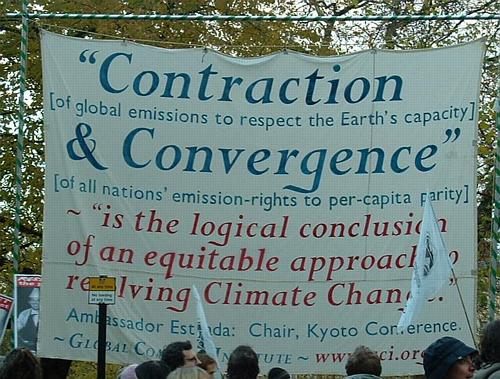
The best way to do this would have been for the G8 to have accepted that
contraction and convergence.”
Labels: international policy

Labels: australia, coal, international policy


In around two weeks Campaign against Climate Change and London School of Economics and Political Sciences are putting on a joint climate conference in order to promote this years international day of climate action.Labels: international policy


With one dynamic moderator and two dynamic speakers bringing valuable information and insight to the table, the November 9, 2006, panel held at the Academy would have been a success even if no questions had been invited from the floor. But questions were invited, and the invitation unleashed a vigorous response from attendees, who not only posed penetrating queries but also added strong views of their own. With those exchanges, the audience became a fourth important contributor to the proceedings.Speaker one: Luis G. Martinez (Audio and Slides)
Labels: economics, international policy

Europe has agreed, to a renewable energy and climate plan.
One interesting aspect of the last minute wrangling is that not every nation will have to meet a 20% target but that the EU will negotiate burden sharing later. I find these complexities fascinating. If we imagine each European nation taking on a 20% target then the consequence overall would include some meeting the target, a few in non compliance doing worse, and probably quite a few doing better, due to domestic measures already commited to. The question therefore is how do you create an equivalent policy that represents the same gains? Most likely tough targets will be given to nations that are either already committed or are pre-disposed to. Whilst we can still reach the 20% per country average this way, we do not reach a 20% per country minimum. I feel like i could do with a diagram, but hopefully you get the picture. It is of course possible that there is less non-compliance along with lower numbers of countries exceeding there targets (which are ambitious where easily achieved) but it is still an interesting question. Perhaps it could be said that an aggregate target will allow the low hanging fruit to be utilised more completely due to the details of the agreement, but as these fruit are low hanging it is more than likely that they would have been picked anyway. The countries with pore renewable resources will not however aim high so in reality the effect will be less. Any thoughts?Labels: energy and efficiency, europe, international policy