Friday, May 14, 2010

Forget aid: just stop robbing us!

British oil company Tullow & UK Embassy push disputed deal that could cut Congo's revenues by $10 billion

Confidential oil contracts held by UK companies Tullow and Heritage in the Democratic Republic of Congo were leaked today, revealing the danger of economic rip-off and rights abuses in one of Africa's most unstable countries.

The Production Sharing Agreements (PSAs) are accompanied by a legal analysis,

''A Lake of Oil - Congo's controversial contracts compromise rights, environment
& safety''

published by oil watchdog PLATFORM in partnership with the African Institute for Energy Governance (Afiego). [1]

As the dispute between Tullow/Heritage and the South African-led Divine Inspiration consortium over lucrative oil licences on Lake Albert comes to a head [2], the contract terms have been released for the first time.


[3] PLATFORM's analysis compares revenues delivered by two competing contracts, revealing that:


  • Both Tullow/Heritage & Divine/H Oil's contracts guarantee excessive profits, at the expense of Congo's poor

  • Tullow's contract terms reduce the Congolese take by around 15%, compared to Divine's.

  • If recognised, Tullow's contract will cut Congolese government revenues by over $10 billion - a figure equivalent to the country's entire national debt.

  • Tullow and the British Embassy in Kinshasa have been lobbying hard for these contract terms.

  • This represents a significant transfer of wealth from some of Africa's poorest to British and Irish investors.

In ''A Lake of Oil", PLATFORM also raises concerns about:


  • Co-operation between oil companies and military groups and the likelihood of escalating resource-driven war in eastern Congo. (p26 & 33)

  • The legal rights granted to flare natural gas (p.24)

  • The complete absence of penalties for environmental damage (p.21),

  • The 'stabilisation clause', which will restrict DRC's ability to improve its environmental protection and human rights standards in the future (p.27)

Alfred Buju, head of the Justice and Peace Commission in Ituri, DRC, at the heart of Exploration Block 2, said:


''This report reveals the contracts that will affect our communities and raises
serious concerns about who will benefit from oil extraction in Ituri. We need
the government and international companies to be honest and clear - will our
environment be protected? The history of natural resources in eastern DRC makes
us worry that oil will lead to more conflict.''


PLATFORM Campaigner Mika Minio said,


''The reality is that extracting Congolese crude will escalate resource wars,
transfer wealth from Congo's poorest to London's richest, create new health
problems for local communities, increase corruption and pollute the land, water
and air. It is up to social movements and civil society to create the pressure
to defend rights, livelihoods and Uganda's rich environment."

NOTE 1:
The analysis was carried out by PLATFORM, in partnership with the African Institute for Energy Governance
The report is available at http://www.carbonweb.org/drc

NOTE 2:
The Congolese blocks on Lake Albert are widely assumed to hold large reserves of crude oil, following Tullow and Heritage's major discoveries on the adjoining blocks on the Ugandan side of the border. See http://www.carbonweb.org/uganda/

NOTE 3:
PLATFORM has obtained and released copies of Tullow/Heritage’s 2006 PSA for Blocks 1 & 2 and Divine Inspiration/H Oil's 2008 PSA for Block 1, on Lake Albert. The 2006 contract is disputed by both sides since the Congolese Ministry of Energy appeared to annul it in October 2007, prior to reassigning Block 1 to the Divine Inspiration consortium in 2008. The Congolese government has expressed a desire to finalise the status of contracts and begin exploration during 2010.

Labels: , , , , ,

Climate Change Action

Home furl google deliciousdel.icio.usnetvouz newsvine diggDigg This!reddit spurl Technorati

Enter your Email


Preview | Powered by FeedBlitz

Sunday, January 27, 2008

Al Gore and Bono speak at the 2008 World Economic Forum in Davos


Bono, Al Gore with Thomas L. Friedman speak at the world economic forum. This is an interesting video, my favourite part was al gore saying 'we need to change lightbulbs but its better to change laws'.


Labels: , ,

Climate Change Action

Home furl google deliciousdel.icio.usnetvouz newsvine diggDigg This!reddit spurl Technorati

Enter your Email


Preview | Powered by FeedBlitz

Saturday, January 19, 2008

Tiempo Climate Newsletters #64 and #65

The latest two issues, #64 & 65, of Tiempo: I like to pick these up at they are released so sorry about that delay. The Tiempo newsletter focuses on adaptation and development in the global south. The publication is a joint project of IIED and SEI.


Issue 65 Contents:

  • National Adaptation Programmes of Action (NAPA). (Mohazurul Alam)
  • The Sudanese NAPA. (Sumaya Ahmed ZakiEldeen and Nagmeldin Goutbi Elhassan)
  • NAPA priorities to policies. (Bubu Pateh Jallow and Thomas Downing)
  • Leassons learned in Africa. (Balgis Osman-Elasha and Thomas Downing)


Issue 64 Contents:
  • Flooding and the urban poor. (Ian Douglas et. al.,)
  • Climate risk integration. (Bert Koenders)
  • Adaptation targets. (Ian Tellam)
  • Community Adaptation. (Roger Jones and Atiq Rahman)
  • Roadmap for Adaptation (Gary Yohe)

Labels: , , , , ,

Climate Change Action

Home furl google deliciousdel.icio.usnetvouz newsvine diggDigg This!reddit spurl Technorati

Enter your Email


Preview | Powered by FeedBlitz

Thursday, January 17, 2008

UNDP 2007 Human Development Report

The 2007 Human Development Report made a bigger splash than any other report, bar the IPCC's latest edition. Going into Bali the report was big news, around the world, but perticularly in the nations of the global south. Now UNDP have created a superb video explaining the reports conclusions, it is very compelling viewing, highly reccomended.


Related:

Labels: , , , ,

Climate Change Action

Home furl google deliciousdel.icio.usnetvouz newsvine diggDigg This!reddit spurl Technorati

Enter your Email


Preview | Powered by FeedBlitz

Tuesday, July 10, 2007

News Roundup Top 5

Here are a few of my favourite climate change stories of late...

1. Darfur is connected with climate change by UN Secretary General. This connection has often been made by others, but received some attention this time!

2. The UN Global Compact has released a report on the state of responsible competitiveness, read this with a big dose of skepticism, but remember its not always greenwash all the time!

3. Al Gore launched Live Earth in Tokyo via hologram!

4. RFK Jr. gives an amazing speech at live earth, the transcript is well worth a read. As an aside, someone bought me a book he wrote on environmental protection but due to his cape wind stance i have never read it...can someone truly be passionate about the environment and be that resistent to an offshore wind farm? Still, the transcript might be usefull in deciding how to frame your arguments.

5. The WBCSD have teamed up with the members of the aforementioned global compact to produce a statement on what the business community needs in order to move rapidly towards a low carbon future. The WBCSD are THE place to go if you want to understand the sort of agreements and regulations that are needed in order to effectively address climate change.

Labels: , ,

Climate Change Action

Home furl google deliciousdel.icio.usnetvouz newsvine diggDigg This!reddit spurl Technorati

Enter your Email


Preview | Powered by FeedBlitz

Monday, July 09, 2007

Guest Post: Alternatives to slash and burn.

By Jessica Schessler
jessica.schessler(at)gmail.com

Obviously, rainforest destruction is a heated topic of discussion. Many popular websites claim to plant trees in exchange for donations, and even Dell has hopped on the bandwagon. When you buy a new computer you can select “plant a tree for me” as you checkout and help offset your carbon footprint. Planting trees can be a good thing, but are we really making progress if we do nothing about the source of the problem? Sustainable Harvest International is heading straight for one source. This small non-profit organization
“has worked with nearly 1,000 families and 900 students in Honduras, Panama, Belize and Nicaragua implementing alternatives to slash-and-burn farming, the leading cause of rainforest destruction in the region.”

Malnutrition is a huge problem in this area of the world, and many vegetables are considered a luxury item. SHI teaches new farming techniques to the local families, such as alley cropping, organic vegetable gardening, and seed saving and storage.


Since 1997, SHI has successfully:
  • Planted more than 2,000,000 trees.
  • Converted 6,000 acres to sustainable uses, thereby saving 30,000 acres from slash-and-burn destruction.
  • Improved nutrition through the establishment of more than 200 organic vegetable gardens.
  • Increased farm income up to 800%.
  • Built 165 wood-conserving stoves (saving 1,650 trees per year)

“…slash-and-burn practice is very shortsighted and damaging to forests… Removal of the vegetation not only destroys the habitat for numerous species of plants and animals, but it also can lead to soil erosion, watershed degradation, and climate change in the area. Once the vegetation is removed the rapid processes of plant growth, death, and decay that created the fertile environment are severely limited or entirely destroyed.” (1)

This farmer living near the Panama Canal has learned that growing rice in paddies instead of using slash and burn improves his yield by 400%-800%, without the need to cut down any forests.


What better way to stop slash and burn than with education in alternative farming techniques? SHI’s programs not only help out the farmers and their families, but the environment as well.

Check out http://www.sustainableharvest.org to find out more about SHI!

(1) http://www.cotf.edu/earthinfo/camerica/CAdef.html

Labels: , ,

Climate Change Action

Home furl google deliciousdel.icio.usnetvouz newsvine diggDigg This!reddit spurl Technorati

Enter your Email


Preview | Powered by FeedBlitz

Saturday, June 30, 2007

Inuit activist honoured by the United Nations for climate change work.

An Inuit activist is honoured by the United Nations Developmet Program for highlighting the harmful effects of greenhouse gases on Arctic communities.


Summary of arctic impacts.

From the arctic peoples website:

The impacts of change

Evidence of climate change is being seen right now in indigenous communities in the Arctic. Some people outside of the Arctic assume that climate change would be a good thing for Arctic peoples, if it means that the weather will get warmer. Unfortunately, that is unlikely to be the case. Arctic peoples are well adapted to their environment, and to using the plants and animals that are adapted to the cold northern weather. As the weather gets warmer, people, plants and animals are becoming stressed.

Saami are seeing their reindeer grazing pastures change, Inuit are watching polar bears waste away because of a lack of sea ice, and peoples across the Arctic are reporting new species, particularly insects. Some communities are having to sand-bag their shorelines to try to slow down an increase in coastal erosion, while in others, buildings, pipes, and roads are slumping because the permafrost is thawing. Vital travel routes linking communities to each other and to harvesting sites are becoming dangerously unpredictable. Routes across the ice become dangerous when the ice thins, or thaws at times different from the past, and water routes can also become dangerous as water flows change.

Labels: , , ,

Climate Change Action

Home furl google deliciousdel.icio.usnetvouz newsvine diggDigg This!reddit spurl Technorati

Enter your Email


Preview | Powered by FeedBlitz

Monday, June 25, 2007

Indigenous Peoples at the Arctic Council

Cutting out the middleman, a superb concept, perhaps most brilliantly communicated by Douglas Adams in 'Hitchhikers Guide to the Galaxy' is made possible in relation to climate change thanks to the blog of the "Indigenous Peoples at the Arctic Council".

Definetly worth a visit...

Labels: , ,

Climate Change Action

Home furl google deliciousdel.icio.usnetvouz newsvine diggDigg This!reddit spurl Technorati

Enter your Email


Preview | Powered by FeedBlitz

Sunday, May 27, 2007

Latest Climate Change and Development Bulletin


Issue 63
of the quarterly bulletin is now on-line,
featuring articles on on
health and climate in Kashmir, environmental stress and climate change and
gender issues...


In the latest issue of Tiempo Climate Newswatch, a weekly online news magazine
on climate and development...

News of the latest IPCC assessment of climate mitigation options...
 
Plus the latest news on...

  • Bonn climate negotiations

  • WWF mitigation report

  • Migration and climate change

The Current Climate section now includes the latest monthly data for global
temperature and the Southern Oscillation as well as access to a mosaic of global
webcam skyviews...

Labels: , ,

Climate Change Action

Home furl google deliciousdel.icio.usnetvouz newsvine diggDigg This!reddit spurl Technorati

Enter your Email


Preview | Powered by FeedBlitz

Monday, May 14, 2007

Human Tide: The Real Migration Crisis

This week's report of the week is by christian aid. Entitled "Human Tide: The Real Migration Crisis" this latest report looks at one of the greatest potential impacts of climate change, the distinctly human rather than environmental impact of mass migration.

"At least one billion people will be forced from their homes between now and 2050 as the effects of climate change deepen an already burgeoning global migration crisis, predicts a new Christian Aid report."
A great number of development organisations are now looking at climate change, and issue that is so huge as to be a daunting addition to these groups doing very direct and worthwhile development work...but it is becoming increasingly obvious that climate change threatens to wash away any hope of development for the poor, hence christain aids latest climate campaign.

Links bellow to the climate change sections of a few development organisations.

Oxfam, World Development Movement, MedAct, RedCross,


Labels: , ,

Climate Change Action

Home furl google deliciousdel.icio.usnetvouz newsvine diggDigg This!reddit spurl Technorati

Enter your Email


Preview | Powered by FeedBlitz

Wednesday, April 11, 2007

Jeffrey Sachs gives this years Reith Lecture to the Royal Society (Broadcast on Radio 4 and BBC 2)

Columbia University economist Jeff Sachs gives the first in this years Reith lecture series, entitled "Bursting at the seams" Sachs is truly an insperation. A great lecture and I don't think that he strays far from my views on anything throughout this first lecture of the series. With talks like this one we are left to wonder, couldn't somone like Jeff ever be president of the US? He certainly represents America well.


Todays lecture and futher episodes will be available here both as streaming audio and as mp3 files.

Sachs speaks of the true challenges that we face today, challenges that are not 'us Vs them' but 'us together for a common challenge' these are the challenges that are currently so poorly delt with.

Species loss, destruction of fisheries, fighting climate change, providing health care and basic facilities for the poorest billion people on the planet. Sachs is a radical, he believes that we can, and that we must deal with the roots of problems not the manifestations of these problems.

Technology has advanced hugely, the economy is stronger than ever, we can achieve huge changes with relatively little effort, we need to evolve the international institutions in order to enable a more reasoned and less reactive mode of international relations.

Labels: ,

Climate Change Action

Home furl google deliciousdel.icio.usnetvouz newsvine diggDigg This!reddit spurl Technorati

Enter your Email


Preview | Powered by FeedBlitz

Monday, March 12, 2007

Climate Change: Latin and South America

I thought i`d take a look at Latin America and climate change. I havent written on this before so it makes a nice change, an i`m intending to write an article for Temas on this topic.


It's remarkably difficult to find information about the region that dosent originate from outwith. This information is perfectly valid but it's difficult to be sure that it reflects the concerns of the people who live in the region and face the local manifestations of climate change.


Climate change as an issue has several angles: Causes; Environmental and Human Impacts, and Solutions. These are not seperate by any means but worthy of individaul aswell as join inspection.


Background on Latin America can be found here, a list of the main relavent climate change issues can be found here. My previous relavent content can be found under the southamerica label.

A few resources that are relavent to this area.

  • Latin America's (natural and human) contribution to climate change.
  1. Fosil Fuel Usage C2,C4,C5,
  2. Deforestation and Fires C1,C2,C3,C6,C7
  • Environmental and Human impacts of climate change in Latin America. (Map:which nationshave assesed this?)
  1. Impact on farming. I1,I5,I8,A3
  2. Impact on health. I1,I8,A3
  3. Impact on economy. I2,I5,I6,I7,A3
  4. Impact on environment. I1,A3
  5. Impact of rising sea levels. I3,A3
  6. Impact of migration. I4,A3
  • Some possible ways to mitigate climate change contributions and adapt to inevitable impacts.
  1. Protecting forests. M1,M2
  2. Alternatives to Oil, Coal and Gas.M2,M3
  3. Adaptation of climate change.A1,A2,A3,

Some good sites with more information.

  1. Amazon Watch
  2. Carribean Environmental Health Institute
  3. The Panos Institute of the Carribean
  4. Adaptation days at COP 11

Labels: , , , , , ,

Climate Change Action

Home furl google deliciousdel.icio.usnetvouz newsvine diggDigg This!reddit spurl Technorati

Enter your Email


Preview | Powered by FeedBlitz

Thursday, February 15, 2007

Tiempo:Climate and Development Bulletin

Tiempo Climate and Development Bulletin

Tiempo 62

Latin America up in smoke


Hannah Reid and Andrew Simms describe climate change impacts in Latin America and the Caribbean.

Climate and disaster reduction


Sarah Granich reports on the need for appropriate disaster
reduction strategies.

Vulnerability in Sudan

Sumaya Ahmed Zaki-Eldeen calls for improved policy process integration to support adaptation.

Operating the adaptation fund

Amjad Abdullah, Bubu Pateh Jallow and Mohammad Reazuddin describe a new proposal for operating the Kyoto Protocol Adaptation Fund.

Tiempo 61

Desertification and climate

Desertification Secretariat staff argue for a joint approach to climate change and desertification.

Climate change and the Sahara

Guy Jacques and Hervé Le Treut describe the role of climate in shaping the Sahara.

Food security in the Solomons

Louise Hunt reports on the efforts of a community group to teach capacity strengthening.

Institutions for adaptation

Evans Kituyi describes how scientific institutions in Africa could better influence national policies.

The story of the Yellow River

Li Moxuan describes the impacts of climate change.


Tiempo 60

Climate impacts on Nepal

Anil Raut discusses the impact of climate change on Nepal and options for adaptation.

Electric vehicles in Nepal
Megesh Tiwari describes the use of electric vehicles in Nepal.

Clean development in Nepal


Noora Singh considers the future of the Clean Development Mechanism.

Designing adaptation projects

Mozaharul Alam and Lwandle Mqadi describe a novel way of identifying, designing, implementing and monitoring community- based adaptation projects.


Gender and climate change.

Ulrike Röhr discusses the assimilation of gender issues in the climate change debate.

Deserts and desertification


Sarah Granich reports on the International Year of Deserts and Desertification


African fisheries

Friday Njaya and Charlotte Howard describe climate change impacts on fisheries in Malawi

Rural livelihoods

Jennifer Pouliotte, Nazrul Islam, Barry Smit and Shafiqul Islam assess adaptive capacity in Bangladesh

Low coastal zone settlements
Gordon McGranahan, Deborah Balk and Bridget Anderson describe the global distribution of low coastal zone settlements.

Labels: , , ,

Climate Change Action

Home furl google deliciousdel.icio.usnetvouz newsvine diggDigg This!reddit spurl Technorati

Enter your Email


Preview | Powered by FeedBlitz

Wednesday, February 07, 2007

Website of the Week: ISET

This week the website which I would like to draw some attention to is that of ISET.

According to the website:


ISET is an international partnership for implementation, education and research on natural resources & the environment.

More plainly, they are an organisation who have produced reports on water management, adaptation to increased risk of flooding, and the policies required for combining development and adaptation to climate change.

In general many developing nations, perticularly those not as far along the path of development as china, see adaptation to climate change as there big challenge. Looking at the growth of some of these nations will lead many in the west to hope that this will change. The continuing widespread poverty in many areas of Asia, is perhaps masked by such gross statistics as GDP growth that we are bombared with.

Combining clean development with adaptation is becoming more a more an more urgent issue, and is gaining support. A couple of the key organisations in this field of research are TERI (India) and BCAS (Bangladesh), both of whom contribute to a recent report published in
conjunction with ISET.

Labels: , , , ,

Climate Change Action

Home furl google deliciousdel.icio.usnetvouz newsvine diggDigg This!reddit spurl Technorati

Enter your Email


Preview | Powered by FeedBlitz

Review: The Great Warming -- A Christian Perspective

Climate change, a christian perspective, an argument for action on climate change based on our common humanity. The Great Warming is a facinating fresh perspective on the problem of climate change.

We don't have the flash graphics and the head on approach of An Inconvenient Truth; we have a very nicely put together documentary about the impacts of climate change, focusing on human health, agriculture and personal stories.

This angle, along with the neutral term Great Warming, does well to move past the negative association that many US christians have with environmentalism. It seems obvious to many that climate change is a moral issue, perhaps to obvious for the comfort of those of us involved in this issue within a secular society. The involvement of the chirstian community therefore makes perfect sense, but how to get this 'creation protection' started? The great warming is a superb start, it's suitability for church groups and it's solutions based approach are most wellcome!

"In a couple of hundred years people will look back at us as we look back at the Bronze Age and the Stone Age, and we’ll be called the Fossil Fuel Age.”
"We are living at the dawn of a new age – an era of changing climate, erratic weather, and social calamities that could change our way of life forever."


If you wan't to make the case for conservation, for low impact living, in your community and the thought of somone as strongly associated with the Democrats as Al Gore dosent seem appealing then The Great Warming could be for you!

Clip from the film...


Background
Get Your Copy/Get Involved

Labels: , , ,

Climate Change Action

Home furl google deliciousdel.icio.usnetvouz newsvine diggDigg This!reddit spurl Technorati

Enter your Email


Preview | Powered by FeedBlitz

Tuesday, January 30, 2007

In the Philippines El Nino Means Drought and Huge Carbon Release

According to Columbia University's International Research Institute for Climate and Society (IRI) El Nino cycles are associated with drought in the Philippines.

"Droughts are not generally associated with the Philippines, a country known for its steamy tropical marine climate. But during El Niño cycles, much of the country experiences moderate-to-severe dry periods that can last for a season or more."

This causes a range of problems, both social and environmental.

"[In] Manila, home to more than 10 million people, it is drought — not typhoons — that has led to rising tensions between urban dwellers and farmers who work just outside the city."

"According to the IRI, during El Niño, the water inflows into the Angat reservoir are often significantly decreased, placing substantial duress on the domestic water supply and irrigation needs of farmers."

Whilst the verdict is still open on how the El Nino effect will be altered by climate change, the prevailing view seems to be that the base state of the atmosphere--the normal mode--will become more El Nino like. According to RealClimate there is still much uncertainty as to how this will effect the events themselves, will the fluctuations remain the same (which would lead to more extreme floods and droughts if the atmosphere is already El Nino like) or will the events be tempered (leading to similar levels of extreme events)?

One very recent paper in the journal Nature suggests that extreme droughts and floods will indeed become more prevalent. According to RedBolivia:

Climate experts say new evidence suggests Indonesia's seasonal rains will diminish as global temperatures continue to rise.

That could mean a devastating blow to the country's tropical agriculture and spark more haze-producing wildfires each year.

A new study used samples of coral to track rainfall patterns from more than 6,000 years ago. The study was published a few days ago in the journal Nature.

Study co-author Nerilie Abram says the new data suggest an unexpected link between monsoons and droughts in countries surrounding the Indian Ocean.

"And so the implication is that with monsoon strengthening we expect that parts of Asia and India, where you receive monsoon rainfall, are likely to get wetter. But the knock-on effect is that parts of Indonesia and Australia are likely to get dryer," said Abram.

This year's drought in Indonesia is caused partly by a natural cycle of cooling in the Indian Ocean much like the El Nino phenomenon in the Pacific Ocean.

Despite this latest piece of science leading us to suspect a link between climate change and ever stronger droughts in Indonesia the media are by and large continuing there miserable failure to connect the dots. The International Herald Tribune writes that inflation is up in Indonesia but completely fails to mention any possible link between climate change and this economic effect! Another issue where there is no definitive evidence of a climatic cause but where this link is extremely likely and where key drivers are certainly environmental rather than political is the situation in Dar fur, but this is miraculously under reported.


Drought in Indonesia is, however, not simply worrying for the farmers and the nations economy but for the global community. Thanks to rampant deforestation of old growth rain forest and the expansion of agriculture--particularly palm oil plantations into the heart of Indonesia--the number of forest fires has increased dramatically. These fires are not, however limited to the dessicated fringes of rain forest but in many cases have led to the burning of the peat substrate on which the rain forests and newly planted crops reside. Palm oil production in particular is having disastrous effects on the global carbon cycle, high carbon bogs have to be drained in order to create palm oil plantations. Greenhouse gas emissions from this process across Indonesia have insured that in times of extreme drought due to strong El Nino Indonesia has--according to many estimates--supplanted the US for a time as the worlds largest contributor to climate change. Palm oil is, ironically, being used more and more as a source of that green fuel Biodiesil!

Further Reading:

Palm Oil and Peat Fires in Indonesia: Biofuelwatch
Indonesia, Peat Fires and Climate Change: New Scientist
Dar fur and Climate Change: Climate Change News

Labels: , , , , ,

Climate Change Action

Home furl google deliciousdel.icio.usnetvouz newsvine diggDigg This!reddit spurl Technorati

Enter your Email


Preview | Powered by FeedBlitz

Thursday, January 18, 2007

Guest Post by Almuth Ernsting: The Global Blueprint for A Biomass Economy

THE GLOBAL BLUEPRINT FOR A BIOMASS ECONOMY

A year ago, my MEP sent me a curious statement which said that growing biofuels could not just reduce carbon emissions, but would actually cool the planet. I believed that he had been misinformed, perhaps by proponents of the biofuel industry. I was wrong. Those claims, improbable as they are, pervade top scientific institutions.1

First, let us think back to early in 2005, when catastrophic global warming hit the news as the biggest climate science conference opened in Exeter.2 Frightening evidence of climate change impacts and possible disastrous feedback mechanisms were published. Most studies presented forecast a decline in grain yields, an expansion of deserts and a shrinking of the arable and habitable parts of the planet even at levels of warming which are probably now inevitable. The collapse of the Greenland and West Antarctic ice shelves, of the Amazon rainforest, and perhaps even of the Thermohaline ocean circulation were shown to be real risks if greenhouse gas levels could not be stabilised quickly.

Whilst the media widely reported on the scary findings presented by climate scientists, the second part of the conference had a much lower profile: Recommending pathways which would help to stabilise the climate. This is the remit of Working Group 3 of the Intergovernmental Panel on Climate Change (IPCC). Perhaps the most important paper submitted in this context was Pascala and Socolow’s proposal for ‘stabilisation wedges’.3 Pascala and Socolow argue that we need to choose from a range of technologies which we must employ on a large-enough scale so that together they reduce emissions enough to stabilise greenhouse gas concentrations in the atmosphere. Whilst most people would agree with the approach in general, the choice of technologies and the claims made for them are more problematic: One of the ‘wedges’ consists of having two billion 60mpg cars running on 100% biofuels, produced by 250 million hectares of high-yield crops, equivalent to one-sixth of the world’s cropland. It is interesting to read the authors’ definition of ‘sustainable’ biofuels: “A sustainable biofuel is one obtained from plants that are replaced by new plants at the same rate as they are used”. That’s it.


Another ‘wedge’ consists of ending deforestation and reforesting 250 million hectares in the tropics or 400 million hectares in the temperate zones.4 How this is compatible with the land requirements for biofuels in a world of falling grain yields and shrinking arable land, I do not know.

Yet Pascala and Socolow did not actually suggest that biofuels would cool the planet. That idea came from two other contributors to the same conference, who appear to have a high profile within the IPCC Working Group 3: Peter Read and Jonathan Lermit. They believe that biofuels are carbon neutral because they only release the carbon which they take out of the atmosphere whilst they grow. If we burn them and capture and sequester that carbon in the process, then we will be extracting carbon from the atmosphere and, if we do it on a large-enough scale, we will be cooling the planet. A large-enough scale, according to Read and Lermit, means using 40% of all arable land for bioenergy crops. How can we squeeze so much more production out of the land? We do so by intensifying agriculture across the developing world, farming all of Africa as intensively as Holland is farmed5. The promised result? A world where “the More Gas You Guzzle the Greener You Are”.

Putting hundreds of millions of hectares of land under energy crop monocultures and intensifying agriculture across the developing world is quickly being endorsed as a model for saving us from catastrophic climate change. Detailed studies have been carried out for the IEA as to how this plan can be put into action. Perhaps the most important one is the ‘Quickscan of Global Bioenergy Potentials by 2050’6, published by the International Energy Authority. This provides a blueprint for increasing the global production of food, animal feeds and growing vast amounts of energy crops without increasing the global area under agriculture. Those ‘sustainable biofuels’ must be produced essentially by eliminating traditional grazing and pasture economies and low-intensive and subsistence farming across the global South, and particularly across Africa. It is up to national governments to decide whether rural communities should have a share of the profits.

Northern NGOs, governments and scientific advisers working hard to translate the global blue-print into feasibility studies and policies for the global South: Maps or countries and continents are divided into ‘zones’ of different monoculture plantations for which they are deemed to be ‘suitable’.7 Whilst ancient forests maybe spared on paper, grasslands and low-impact agriculture and vast numbers of species which depend on them are dispensable, sacrificed for the greater good of efficiency and fuel production. Experts have little regard for ‘social factors’ – such as the inconvenient fact of that land being home to millions of people. It is hardly surprising that many southern NGOs speak of colonialism: The maps bear an eerie resemblance to those drawn up in Europe during the ‘Scramble for Africa’ of the 1880s.

With scientific endorsement, support from governments, many NGOs and the UN, new partnerships are being formed between the biotech industry, oil companies and big agri-business. They are investing billions of dollars in the firm belief that their access to land and control of the supply chain are secure.

Those who defend the global bioenergy blueprint unfortunately ignore the nature of the ecological disaster now threatening human civilization, the reality of today’s world and, worst of all, the certain reality of tomorrow’s world.

Bad science?

All of the optimistic bioenergy scenarios assume that food production is not just secure but going to increase, without eating further into ancient forests and conservation areas. As Eduardo Pereira de Carvalho, president of Unica, the union of cane-growers in Sao Paulo states: “As for conflict between food and energy, the fantastic increase in productivity has made all these Malthusian arguments completely nonsense, and we have hundreds of millions of hectares of idle land”8. This optimism defies reality: Satellite images confirm advancing deserts across vast regions including north-central China (where two large deserts are about to merge and have already destroyed 24,000 villages in what was once fertile land), Kazakhstan (which has abandoned half its crop land since 1980 due to desertification), Afghanistan (where agriculture is being squeezed out by sand dunes and 100 villages have been lost), northern Africa (with Algeria now abandoning grain production in parts of the country), Mexico, and north-east Brazil.9 The biologically productive area of the planet is clearly shrinking, long before global warming inundates vast stretches of land. The Millennium Ecosystems Report, published in 2005 was compiled by thousands of scientists and concluded, amongst other things, that 60% of all ‘ecosystem services’ have been degraded, 25% of the land surface is cultivated, and species extinction rates are 100-1000 times above the background rate. It warned of an accelerating destruction of ecosystem services – even without fully taking climate change projections into account, nor without looking at a possible shift to large-scale biofuel monocultures. Global warming, more frequent and severe heat waves, droughts and floods are a certainty for the coming decades – yet the ‘Quickscan’ report 6 states that it works on the premise that the climate will not change. This should invalidate the entire report. The Hadley Centre, a leading British climate research institute, predict that, ‘business as usual’ will lead to half of the planet suffering from drought and one-third turning to desert in coming decades.10 Over the last three years, Europe’s per hectare rapeseed yields have been falling due to ‘extreme weather events’11. Global grain production has not reached the 2004 levels in either of the past two years, and world grain reserves are being drawn down as a result, raising the cost of staple food12. A 2006 study of 700 experts, published by the International Water Management Institute and backed by the United Nations found that one third of the world’s population are now affected by water scarcity. It predicted that, based on forecasts for population and food demand growth, water use would increase by 80% by 2050, and that growing biofuel crops will put further stress on ever scarcer water resources.13 On current and predicted climate trends, it is very difficult to see how people’s water needs can be met in future even without biofuels.

Claims about ever-rising yields and the availability of vast areas of agricultural land no longer needed for food production sound like wishful thinking rather than good science. If the blueprint can’t work without great harm in today’s world, it certanly won’t work in tomorrow’s world.

Surprisingly, I have been unable to find a single peer-reviewed paper which suggests that the main biofuel feedstocks – palm oil, soya, sugar cane and jatropha actually have lower life-cycle greenhouse gas emissions than fossil fuels at all. There is simply no evidence to show that they are climate friendly. Lots of studies exist about emissions linked to biofuels produced in Europe and the United States: We know, for example, that biofuels from rapeseed oil and sugar beet are linked to lower emissions than diesel or petrol, provided that no new, natural land is put under the plough - but also that thy can only replace a fraction of our energy use. Germany uses 12% of its cultivated land for biofuel crops and can’t get beyond 2% of transport fuels without imports. So why is there no peer-reviewed evidence on whether the tropical crops so widely promoted for biofuels are actually good for the climate?14 Could it conceivably be because a truly independent study on their life-cycle emissions might demolish the case for using them once and for all?
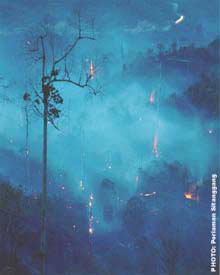
At last, one study which looks at the overall emissions from biodiesel made from palm oil grown in South-east Asian peatlands will soon be published in a journal.15 This study uses very conservative figures: It counts emissions from peat drainage, but not from the vast annual fires set by plantation owners. From those conservative figures, it finds that a tonne of palm oil used for biodiesel from peatlands in that region is linked to the emission of 10-30 tonnes of CO2. This is 3.6 to 10.9 times as much CO2 as would be emitted from burning the same amount of diesel. This is the only independent study on life-cycle emissions for a tropical biofuel feedstock which I have ever seen.

The sustainability promise:

I have seen no scientific paper nor pro-large-scale biofuel institution which agrees with destroying rainforests to make way for energy crops – virtually all the organisations and papers which call for massive expansion of energy crops insist that this need not and must not happen. Yet, unfortunately, biofuels are being introduced into a world run largely on neo-liberal principles – or, to be more specific, within trade rules which have a strong bias against regulation and any ‘trade restrictions’ to protect the environment, the climate or communities. Where crops are grown is, by and large, determined by the market – not by scientists and NGOs drafting maps and plans. The market favours those biofuels which are cheapest. Generally that means those with the highest yields, which are tropical starchy and oily plants such as palm oil and sugar cane. Lower-yield crops can capture the market if costs are kept low and governments guarantee an unlimited supply of new land and perhaps even subsidies – soy biodiesel being a prime example. Rainforests, biodiversity, healthy soil and clean water and greenhouse gas emissions remain ‘externalities’ in the accounts, which will inevitably be sacrificed for real quick profits. Take the Indonesian example: Although sustainable oil palm monocultures may be an oxymoron, Indonesia could at least tell its plantations companies that they should plant on the 12 million hectares of rainforest land which they already clear-cut and then abandoned, rather than granting them ever more concessions for new forest land. But plantation companies make far more profits by selling timber than by growing palm oil alone – and they are powerful enough to stop policies which would cut into those profits.

So here is what we are witnessing just now:

Governments, institutions, NGOs and scientists are writing studies, many of them with dodgy claims, which show that biofuels could be grown without destroying any more rainforests, wetlands, peatlands, or biodiversity hotspots. As a result, new markets are created which dramatically up the world market prices of palm oil, soy and sugar cane. On the ground, plantation owners respond by growing more of those crops in the Amazon, in Uganda’s rainforests or in Colombia’s ancient forests and grasslands – unimpeded by regulations and unimpressed by those who tell them that they could be growing them somewhere else. Trade rules, meantime, do not allow for discrimination on goods because of the way they have been produced. Even if Europe might get away with a ban on deforestation diesel, they don’t even want to try. Instead, there is a growing push to use biofuel expansion as a tool for pushing through further trade liberalisation and further barriers to regulation and environmental safeguards in the World Trade Organisation.16

Meantime, companies, like Wilmar International, sign up to the principles of the Roundtable for Sustainable Palm Oil (perhaps safe in the knowledge that they won’t be translated into action probably for years to come), then apply to destroy one of Uganda’s largest rainforsests for a new oil palm plantation and still manage to get World Bank funding.17 In the absence of regulation, certification might at best tell consumers that the particular palm oil they are using comes from rainforest which was chopped down before 2005 whereas less scrupulous customers can get that from more recently destroyed forests. Yet, wherever the particular palm oil delivery came from, burning it will drive up the world market price and boost the profits of the worst and the less bad plantation owners alike.

Biofuels, not climate justice

One of Britain’s leading carbon capitalists and biofuel advocates is James Cameron, founder of Climate Change Capital. He is a long-standing opponent of equal rights to the atmosphere, and an influential supporter of the Kyoto Protocol and its inequitable carbon market. This is how he sets out his dire vision for Africa’s future: “The Africans are in a perilous position. They will not be rescued by 20 years of debate about C&C. Nor will they be rescued by the Carbon Market [or] beneficiaries of [it]. They’re going to have to really look to the possibilities that do exist in altering their economies to cope with very high fossil fuel prices and Climate Change at the same time . . . some combination of looking at land use and land use change issues; of coping more effectively with the water resources which are there; of growing biocrops; of ensuring that renewable energy technology is made available at low cost.”

This is a frank admission by one of the architects and profiteers of the carbon market. He continues to advocate an extension of the present-day unsuccessful and inequitable carbon trading, knowing full well that it will not save Africa from being devastated by climate change, and that the carbon trade will not benefit its people. It does, however, benefit him: Having helped to put the current emissions trading in place, he is now Chief Executive of a very successful merchant banking group which has just raised $380 million under Europe’s Emissions Trading Scheme, money which they will invest in ‘low carbon’ projects primarily in developing nations. Climate Change Capital will be speaking at the Bioenergy Europe Conference in February 2007, a conference which will outline “the latest EU legislation and incentive schemes that aim to produce a dramatic increase in the use of biomass and biofuels across the 25 member states.”18 Clearly, biofuels are a profitable investment opportunity. The above quote about Africa’s future was published by Aubrey Meyer, founder of the Global Commons Institute, who comments: “Cameron adds Africa to the growing pile of discards that the C3 scenario [i.e. the Kyoto Protocol] inevitably causes and the economics of genocide inevitably requires.”19

Where should we stand?

Many European environmentalists have had high hopes for sustainable local biomass from waste or community forestry. We can hold on to those ideals and many small co-operatives are trying to put them into practice. In poorer, low-energy societies, even a small amount bioenergy, from waste or intercropping, could make a real difference to people’s lives – provided that they are able to use it for their benefit, not export it to the richer nations.20

We must remember, though, that biomass from waste will only meet a tiny proportion of our energy demand – there is little chance of it having any measurable impact on our greenhouse gas emissions. Above all, we must remember that the EU Biofuel Directive, UN policies, bilateral biofuel agreements, etc. have nothing whatsoever to do with this ‘green’ idea. They are putting a global blueprint into action which is threatening local communities, biodiversity, water supplies, rainforest and the climate across the globe. If people think that they can sit at stakeholder forums and make this blueprint sustainable then they should take some time out for reading: I would recomment those papers listed above which set out the global biofuel vision, the Millennium Ecosystem Report, and some good summary of climate change impacts.

As one UN Agency, international institution and government after another adopts this global blueprint, or adjusts its policies accordingly, we need to study the plans, and unite for the rights of the hundreds of millions of people who live on land conveniently classed as ‘degraded wastelands’ which are up for grabs. We need to stop the web of biodiversity being destroyed by monocultures grown in the name of climate change mitigation. And we need to speak out against anybody, no matter their scientific degree or qualification, who claims that monocultures can stabilize the climate. There can be no sustainable energy system based on monocultures. Today’s bioenergy revolution is already destroying some of the planet’s vital climate sinks and threatens to greatly accelerate the pace of global warming. Accelerated global warming threatens all our future. We have the evidence. What we now need is a strong global opposition.

  1. See, for example, the editorial in Nature, one of the two most prestigious scientific journals, 7th December 2006
  2. http://www.stabilisation2005.com/outcomes.html
  3. http://www-g.eng.cam.ac.uk/impee/topics/stabilisationwedges/files/Stabilisation%20Wedge%20v1%20PDF%20WITH%20NOTES.pdf
  4. To find out more about the reality of ‘reforestation’, see www.sinkswatch.org/ .
  5. http://www.iaee.org/documents/p03read.pdf
  6. http://www.bioenergytrade.org/otherreportspublications/fairbiotradeproject20012004/quickscanofglobalbioenergypotentialsto2050/index.html
  7. For an example of a bioenergy ‘zoning’ map of Africa, see http://biopact.com/2006/06/sneak-preview-of-biofuels-atlas-great_18.html
  8. “Drink the best and drive the rest”, Nature, 7th December 2006
  9. http://www.earth-policy.org/Updates/2006/Update61.htm
  10. http://news.independent.co.uk/environment/article1786829.ece
  11. http://www.pecad.fas.usda.gov/highlights/2006/06/europe_20_june_2006/
  12. http://www.fao.org/newsroom/en/news/2006/1000365/index.html
  13. http://www.iwmi.cgiar.org/press/coverage/Food%20biofuels%20could%20worsen%20water%20shortages_Reuters.com.pdf
  14. There are studies which look the energy efficiency of tropical biofuels, particularly sugar cane, and there is information about carbon savings from fossil fuel replacement, but no full life-cycle study, which would need to include land-use change emissions.
  15. http://www.wetlands.org/news.aspx?ID=804eddfb-4492-4749-85a9-5db67c2f1bb8 Please note that we have derived at the comparison with diesel by using conversion tables found here http://bioenergy.ornl.gov/papers/misc/energy_conv.html .
  16. http://www.bbj.hu/latestnews/news_21130_biofuel%2Bdemand%2Bwill%2Bmake%2Bwto%2Baccord%2Bpossible.html
  17. http://www.wrm.org.uy/bulletin/100/Uganda.html
  18. http://www.climatechangecapital.com/index.asp (see events for details of the conference)
  19. http://lists.topica.com/lists/GCN@igc.topica.com/read/message.html?sort=t&mid=1720498412
  20. see: http://www.cures-network.org/docs/pos_2006_biofules_brochure.pdf

January 2007

Almuth Ernsting

Biofuelwatch

www.biofuelwatch.org.uk

info [At] biofuelwatch.org.uk

Labels: , , , ,

Climate Change Action

Home furl google deliciousdel.icio.usnetvouz newsvine diggDigg This!reddit spurl Technorati

Enter your Email


Preview | Powered by FeedBlitz

Wednesday, January 17, 2007

Carbon Offsets: Development, Reccomendations and Warnings


I have commented on carbon offsets several times before. I currently have no problem with the use of carbon offsets if they work.

Perhaps that sounds obvious but many greens seem to be weary, not only for practical reasons--and there are a lot of dodgy services out there--but for a whole range of other reasons that i wont venture into here.

If you want to buy a carbon offset then they key desire is for the offset to be genuine, secondary issues such as the affect of the offset on local people and ecosystems are also important.

-----------------------------------------------------------------------------------------------
My Personal Recommendation: MyClimate (Via Sustainable Travel Intnl)
-----------------------------------------------------------------------------------------------

1. Is one tone of emissions reduction actually one tone?
  • Additionality: Is the project being used to claim reductions only happening due to your funding?
If afforestation is used in your carbon offsets you have the added issues of:
  • Permanence: You have to be sure that the carbon will remain 'locked up'.
  • Leakage: Are you sure that new trees won't push farmers onto new land such as old forest which will invalidate the project?
2. Are the projects that you are funding environmentally and socially benign?
-----------------------------------------------------------------------------------------------
A couple of good reports on carbon offsets: Exploring the Market for Voluntary Carbon Offsets and Voluntary Offsets for Air Travel Emissions (Tufts Univ.)
------------------------------------------------------------------------------------------------
Key Points:
  • Caution is advised, regulation is likely to come into place in the coming years but the industry is at a very early stage.
  • Additionality and permanence are virtually impossible to grantee for forestry projects as the effects of climate change on forests are unclear.
  • In terms of transparency and rigour, offsets coming out of the NSW forestry projects are amongst the best around. Carbon Planet uses credits from these sources. In terms of benefits to biodiversity TreeFlights is one of the best companies around; it is arguable that it might be worth buying e.g twice the emissions offsets from organisations like these to ensure that you are truly carbon neutral as well as supporting reforestation with diverse native species.
  • To be guaranteed real and permanent carbon offsets, the best option may well be to avoid sequestration and use projects that involve sustainable development and energy efficiency in the developing world. MyClimate carries out such projects, descriptions of its projects here.
A little more information about MyClimate

Quote from Tufts University Report:

"Despite the high price of their offsets, myclimate’s high project standards, its transparency and good calculator makes it an excellent choice for offsetting air travel emissions."
From Report By REEP:

MyClimate (Switzerland), an NGO founded in 2002 as a spin-off from the Swiss Federal Institute of Technology (Switzerland), offers offsets for air travel and advisory services on carbon management, project development, and environmental communication.

Its target
markets include individuals, travel agencies, and companies. Projects meet CDM criteria and follow Gold Standard guidelines; however, the projects are too small to meet the transaction costs necessary to register under CDM.

MyClimate invests only in renewable energy or energy efficiency projects in developing countries, but specifically states that it does not support forestry sinks projects due to the risk that the carbon might be released back into the atmosphere in the long term. Projects include solar power water heaters in Eritrea and Costa Rica, biomass in India, and methane to sewage in South Africa. Local sustainable development and strict additionality rules are claimed to be foremost priorities for MyClimate. A ‘team of experts’ from the Swiss Federal Institute of Technology is responsible for verifying the projects.

The cost to the customer is EUR 7 / 1000 km for shorthaul flights and EUR 4.5/ 1000 km for long-haul flights, roughly yielding EUR 23/tCO2e.
UK Environmental Audit Committe launch enquiry into offseting.

Who has written on this before (other green blogs): WorldChanging, Grist, Treehugger

Labels: , ,

Climate Change Action

Home furl google deliciousdel.icio.usnetvouz newsvine diggDigg This!reddit spurl Technorati

Enter your Email


Preview | Powered by FeedBlitz

Thursday, January 04, 2007

Audio of the WeeK: Economics vs Environment?

One insidious belief that I have heard repeated several times by a range of people, from policy makers to member of the public and environmentalists is that environmental protection is something which you do when the economy is strong enough.

This paradigm, develop adjust, rebalance...is painful and would be followed only in madness.

If you look at the traditional metrics of economics such as GDP then some very strange things can happen for a time. As we talk of Gross Domestic Product not Net Domestic Product, we can effectively claim wealth by chopping down trees or harvesting all our fish bar none. This is economic prosperity because nowhere is the 'Natural Capital' which is being run down being considered. However, with 6.5billion people on the planet such uses of reserves cannot persist unabated for more than a moderate period of time...then we discover our wealth has been destroyed. This is perhaps the lesser of two reasons that lead us to believe that our environment is not separate from our economy.

The major reason is the existence of Ecosystem Services. In China, deforestation has been banned in some areas, and in fact some huge reforestation projects have been begun. Green Futures magazine had a fascinating article on this recently. The reasons for this are purely economic, a tree is worth more alive than dead. Timber and pulp is of lesser value than the protection from flooding and landslides that trees provide for downstream farmers. Numerous similar examples of highly threatened and highly valued ecological services are outlined in Lester Brown's book Plan B 2.0.

Finally, the Stern Review, recently calculated that unmitigated climate change would cost the world economy 5-20% of it's gdp whereas stabilising concentrations would cost between 1 and 2%. Whatever the exact figures, the message is clear, we live by the green of leaves not the green of notes. Without a stable climate and a thriving global ecosystems we cannot hope to have a thriving civilisation.

The audio bellow touches on these topics, both Edward Wilson and Jeffery Sachs making the real questions clear. A great interview!

Labels: , ,

Climate Change Action

Home furl google deliciousdel.icio.usnetvouz newsvine diggDigg This!reddit spurl Technorati

Enter your Email


Preview | Powered by FeedBlitz

Free DVD: An Inconvenient Truth

Perhaps you tried to view An Inconvenient Truth at the cinemas but it wasn't out where you are? Perhaps you tried on youtube but it was taken down? Perhaps the a video of the original slide show presentation wasnt good enough for you?

Or, none of these apply, you have seen the film and want to help others do so?

An Inconvenient Truth is now available FOR FREE ON DVD! If you want to see this then check out sharethetruth.com. If, alternatively, you would like more people to recieve this chance then join the growing ranks of donors to the fund to keep this resource available.

Labels: , , , ,

Climate Change Action

Home furl google deliciousdel.icio.usnetvouz newsvine diggDigg This!reddit spurl Technorati

Enter your Email


Preview | Powered by FeedBlitz
