Friday, October 10, 2008

Nature loss 'dwarfs bank crisis'

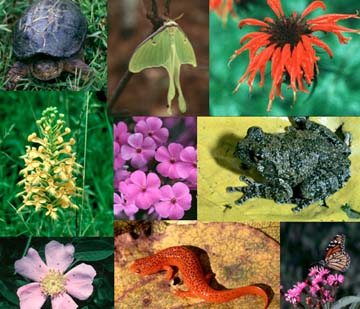
According to a new report comissioned for the European Union the global biodiversity crisis is costing vastly more than the current credit crisis.

Via the BBC:

The global economy is losing more money from the disappearance of forests than through the current banking crisis, according to an EU-commissioned study.

It puts the annual cost of forest loss at between $2 trillion and $5 trillion.

The figure comes from adding the value of the various services that forests perform, such as providing clean water and absorbing carbon dioxide.

The study, headed by a Deutsche Bank economist, parallels the Stern Review into the economics of climate change.

It has been discussed during many sessions here at the World Conservation Congress.

Download the Report:

Labels: , ,

Climate Change Action

Home furl google deliciousdel.icio.usnetvouz newsvine diggDigg This!reddit spurl Technorati

Enter your Email


Preview | Powered by FeedBlitz

Thursday, September 11, 2008

Old-Growth Carbon Findings Cause Forest Protection Schism

New ecological science increases calls for forest protection movement to unite in campaign to protect all ancient forests.

September 11, 2008
By Earth's Newsdesk, a project of Ecological Internet (EI)
http://www.ecoearth.info/newsdesk/


A new study in the journal Nature finds old-growth forests are "carbon sinks" and continually absorb carbon dioxide [1]. Australian researchers recently found logging primary forests releases 40 percent of their carbon [2]. These findings discredit decades of thought that primary forests are carbon neutral and only young forests continue to remove carbon.

The Earth's remaining ancient forests need to be fully protected not just because destroying them will release huge stores of greenhouse gases while destroying biodiversity -- but because science now knows what many of us intuited -- they continue in perpetuity to absorb massive amounts of new carbon dioxide. The environmental movement must respond accordingly.

This causes discomfort for groups like Greenpeace and the Rainforest Action Network (RAN) that actively support ancient forest logging. They campaign for certified industrial first- time harvest of primary forests, and to establish some protected areas, while acquiescing to ancient forest logging
elsewhere. They work to end coal use, but not ancient forest logging. New ecological science indicates their discredited forest campaigns cause climate change and block ecologically
sufficient policies.

Thirty percent of global forests are unmanaged primary forests or regenerating ld-growth forests. These ancient forests in Canada, Russia and Alaska alone absorb 1.3 gigatonnes of carbon annually, about ten percent of global emissions. Much of their carbon, including in the soil, "will move back to the atmosphere if these forests are disturbed... Carbon accounting
rules for forests should give credit for leaving old-growth forest intact," conclude Oregon State University researchers in Nature.

Greenpeace and RAN -- and virtually every major forest campaign -- continue to focus upon establishing protected areas in some remaining wildernesses, and making first-time
industrial logging less damaging elsewhere. After millennia of terrestrial ecosystem destruction by humans, and over a century of failed logging reform, ecologically driven activists question the dominant failed paradigm that logging primeval forests can ever be justified. This has led to a major schism in the forest protection movement, which is not going to go away easily.

Both RAN and Greenpeace recently celebrated Ontario, Canada's promise to protect Boreal Forests in coming decades in exchange for continued industrial development now. Since the
announcement, plans to log old-growth forests in Ontario's Temagami region have been fast-tracked, and logging giant AbitibiBowater has taken the agreement as a green light to
intensify logging. This occurs with Greenpeace and RAN's blessing, because there may be some protections in 15 years.

Greenpeace activists last week boarded a logging ship in Papua New Guinea (PNG) to prevent Malaysian-owned logging company Rimbunan Hijau from exporting timber to China. "We need to
urgently protect these ancient forests to save our climate... Greenpeace is asking the PNG government to establish a moratorium on any new large-scale logging," said campaigner
Sam Moko. Given PNG's two earlier, largely Greenpeace inspired, temporary moratoriums in past decades, that led to no changes in forest policy, perhaps Greenpeace should work to END ancient forest logging in PNG and globally, before the forests are gone.

Britain's Prince Charles called yesterday for the world to act with a "sense of wartime urgency" to protect the rainforests, warning they were "umbilically connected" to the phenomenon of
climate change. The heir to the British throne says rainforests "are the world's lifebelt", acting as the "world's air conditioning system" and helping store the largest body of flowing water on the planet. Such ambitious, ecologically- based policy is welcome from the nation that unleashed industrialism.

For over a decade, Ecological Internet (EI) -- the world's leading exclusively Internet-based forest and climate campaigners -- has called for an end to all primary and old- growth forest logging as necessary to save the Earth's climate and biodiversity. Active campaigns seek to end ancient forest logging in Tasmania, Australia and British Columbia, Canada. EI has campaigned to have Greenpeace and RAN change their forest policies, and given current science, their hand to
continue doing so has been strengthened.

The response has been nearly total silence, with some ridicule and questioning of motives. Yet, there are important discussions regarding how forests relate to global ecological sustainability that must be held, and EI and allies will persevere. Are there enough ancient forests remaining to
sustain atmospheric processes? Can first time industrial logging of ancient forests ever be done carefully enough to maintain carbon, species and other values? Is wide-scale industrial development of primary forests acceptable if indigenous peoples so desire? Why are Greenpeace and RAN stonewalling such important questions?

According to EI President, Dr. Glen Barry, "Greenpeace and RAN must engage in public dialogue, and review their forest campaigns, to bring them up to date with ecological science and planetary conditions. Emphasis must be upon requirements to maintain the Earth's atmosphere and all life's habitats -- regardless of difficulty -- and this means leaving old-growth standing. Until all forest defenders embrace full protection for ancient forests, ecologically sufficient forest campaigns
cannot succeed. Continued refusal makes Greenpeace and RAN legitimate targets of protest."

References:

[1] Old-growth forests as global carbon sinks. Nature 455, 213-215 (September 11, 2008).

[2] Green Carbon: The role of natural forests in carbon storage. ANU E Press (July 2008).


Labels: ,

Climate Change Action

Home furl google deliciousdel.icio.usnetvouz newsvine diggDigg This!reddit spurl Technorati

Enter your Email


Preview | Powered by FeedBlitz

Thursday, August 14, 2008

Land rights key to forest challenge: Report

A new report from the Rights and Resources Initiative finds that land rights are central to the challenge of slowing deforestation. This is a welcome development for those of us who worried about the REDDD clause under the UNFCC turning into a carbon trading clause and a way of disempoering native groups.

“The dramatic shifts under way in markets, politics and the planet’s climate create new and very large challenges for achieving peace and prosperity in forest areas,” the report states. It argues the key to balancing local and global needs lies in recognising and strengthening forest peoples’ property rights. This is the only basis for protecting forest people, providing certainty for outside investors and giving social guidance to conservationists.


Report (PDF)

related:

Labels: , ,

Climate Change Action

Home furl google deliciousdel.icio.usnetvouz newsvine diggDigg This!reddit spurl Technorati

Enter your Email


Preview | Powered by FeedBlitz

Saturday, July 19, 2008

Protecting forests or entrenching inequality?

Deforestation is one of the most avoidable and meaningless sources of carbon emissions in the world. The productivity is appaulingly low. However, some of the frameworks being looked at to solve this problem have been labelled neo-colonial.

The worry is that in much of South America where much of the worlds great forests are to be found, the land ownership is amongst the most unequal in the globe. An artifact of Spannish colonialism the last thing we should be doing is supporting this system by paying for forrest preservation. The real solutions arent simple but land reform is virtually always a part of any realistic social and environmental plan. From past experiance we can make one prediction, if forest owners are paid to keep there forests pristine without a social solution then the local landless class will also be jobless. This will lead to huge numbers of disenfranchised people either moving to the cities or finding themselves on the wrong side of the law in illegal clearings.

Labels: ,

Climate Change Action

Home furl google deliciousdel.icio.usnetvouz newsvine diggDigg This!reddit spurl Technorati

Enter your Email


Preview | Powered by FeedBlitz

Tuesday, May 27, 2008

step one...

As the G8 fudges setting GHG reduction targets and the UK prepares to cave in to the motoring lobby after protests from road hauliers and nervous marginal MPs, Drax covers its arse with a biomass figleaf and Barcelona is forced to import Water from France as the whole region dries up and cracks into lifeless chunks . Meanwhile Brazil's Environment minister gives up the thankless task of defending the rainforest from Big Business in fatigue and disgust.

The good news is that now NASAs Mars lander can thoroughly investigate the chances of life on a barren, airless rock, we can plan for Earth's future on the basis of solid scientific evidence.

On a more positive note - the Germans have finally identified and banned the pesticides decimating their (and everyone else's) bee-hives, Barrats have started building affordable (?) eco-homes and a summit of world leaders in Rome calls for the establishment of a world food fund to address the ever- growing food crisis that their policies have created.

http://www.independent.co.uk/environment/climate-change/i-give-up-says-brazilian-minister-who-fought-to-save-the-rainforest-828310.html

http://www.independent.co.uk/environment/climate-change/g8-frustrates-green-groups-834668.html

http://www.independent.co.uk/news/uk/politics/new-fuel-price-protests-test-ministers-green-resolve-834585.html

It transpires that even the alarmists are now deeply alarmed. All hands on deck.

Labels: , ,

Climate Change Action

Home furl google deliciousdel.icio.usnetvouz newsvine diggDigg This!reddit spurl Technorati

Enter your Email


Preview | Powered by FeedBlitz

Friday, January 18, 2008

...an awful lot of cattle in Brazil.

Deforestation of the Amazon rainforest has picked up speed again after briefly slowing - whilst big business gathered its forces for another assault. Despite (ie-because of) its HUGE ethanol market, Brazil remains one of the big 4 Carbon criminal states - 3/4 of it's emissions coming from deforestation and its aftermath. Still - cheap beef, eh? Fantastic!

Labels: , , ,

Climate Change Action

Home furl google deliciousdel.icio.usnetvouz newsvine diggDigg This!reddit spurl Technorati

Enter your Email


Preview | Powered by FeedBlitz

Thursday, December 06, 2007

Tasmanian Forests Threatened: Video, Campaign Sites and Map

Tasmania has some of the finest, and most unique forests in the world. Unfortunately they are being logged at a frightening pace. However, there are people fighting this disgraceful exploitation of natural wealth.

A description of the problem, along with a annotated google map of the logging sites can be found here, you can zoon in and see the true extent of logging activities. The thing that is amazing about this is that Australia is a wealthy nation so it dosent need to destroy its environment in order support its economy. How can we ask the poorer nations of the earth to give up this practice if enven the wealthy cant resisit making a fast buck?

A personal view on the Huon and Styx valleys can be read here. The video bellow is a superb talk give by Cookie at the camp for climate action.

Labels: , , ,

Climate Change Action

Home furl google deliciousdel.icio.usnetvouz newsvine diggDigg This!reddit spurl Technorati

Enter your Email


Preview | Powered by FeedBlitz

Friday, September 14, 2007

e-action: amazonian dam project threatens bolivian biodiversity

Only a few days left for this one...
=========================

Dear Friends

The Brazilian government is planning two huge dams on the Madeira River, principal tributary of the Amazon, and a region of mega-biodiversity, with 750 fish and 800 bird species.

The dams were granted preliminary approval in July by Brazilian environmental authorities, even after technical experts of the Brazilian environmental protection service Ibama recommended against licensing the project without new studies being carried out.

The Bolivian government have protested, and on August 23rd a decision was made to form 3 bi-national working groups to study the dams' potential impacts on Bolivia.

We need your help - visit our website and sign the petition organised by IRN, Friends of the Earth Brazil & Amazonia Brasileira, and let the Brazilian government know that this is a matter of concern to the international community.

Please pass this message on to your contacts.
Thanks for your support.

Debra Broughton
Friends of the Earth International

Labels: , ,

Climate Change Action

Home furl google deliciousdel.icio.usnetvouz newsvine diggDigg This!reddit spurl Technorati

Enter your Email


Preview | Powered by FeedBlitz

Monday, July 09, 2007

Reducing emissions from deforestation and degredation.


Reducing emissions from deforestation is a pretty awful way of looking at things. To spend a day in a rainforest and walk through one acre, to look at the immense biodiversity, the innumerable forms of life and an almost infinitely complex web of interactions, this is an experience that we should not deny future generations. This beauty should add up to more than just carbon, yet , a new urgency comes to protecting our forests, not because of a new appreciation of there qualities and innate value, but rather because of the dire consequences of there destruction on our planet as a whole. Deforestation is a significant contributor to climate change and many people have been looking at how we can best address the problem.

For an introduction to forest destruction, and what this means for the global climate you might be interested in a recent conference at the Environmental Change Institute of Oxford University. For a four page introduction to the overall discussion, this document may be of interest (draft summary for SB side event 19 May 2006, 18.00-20.00). Also, Environmental Defence have done a great deal of work in the area of avoided deforestation and there page on the topic can be found here.

Finally, a recent conference, addresses the details of how this is implemented...

Session I - Background (9:15 - 10:45)

Chairperson Bernhard Schlamadinger (Joanneum Research)

History of the issue under the UNFCCC, reasons for exclusion of deforestation in the past, and the changes that have occurred since Montreal (Eveline Trines, Treeness Consult, the Netherlands) PDF-File (124 kB)

Magnitude of the problem and underlying causes of deforestation, including social and economic issues (Sven Wunder, CIFOR, Brazil) PDF-File (2.85 MB)

Lessons learned from other national and international efforts to reduce deforestation (Jurgen Blaser, Intercooperation, Switzerland) PDF-File (6.7 MB)


Session II Future policy pathways (11:15 - 12:45)
Chairperson Yoshiki Yamagata (Global Carbon Project)

Coupled climate-carbon-human analysis (Yoshiki Yamagata, Global Carbon Project)
PDF-File (357 kB)

Modelled climate change movie (Yoshiki Yamagata, Global Carbon Project)
MPEG-Movie (15.29 MB) Windows-Mediaplayer or Quicktime required

The role of reducing emissions from deforestation in avoiding danger- ous climate change (Peter Frumhoff, Union of Concerned Scientists, USA) PDF-File (1.67 MB)

Status of the Montreal Mandate and approaches how deforestation could be addressed within a UNFCCC or Kyoto Protocol type umbrella (Ian Noble, World Bank) PDF-File (52 kB)

Policy approaches and incentives within a country an example from Brazil (Thelma Krug, Instituto Nacional de Pesquisas Espacias, Brazil) PDF-File (1 MB)

Labels: , ,

Climate Change Action

Home furl google deliciousdel.icio.usnetvouz newsvine diggDigg This!reddit spurl Technorati

Enter your Email


Preview | Powered by FeedBlitz

Guest Post: Alternatives to slash and burn.

By Jessica Schessler
jessica.schessler(at)gmail.com

Obviously, rainforest destruction is a heated topic of discussion. Many popular websites claim to plant trees in exchange for donations, and even Dell has hopped on the bandwagon. When you buy a new computer you can select “plant a tree for me” as you checkout and help offset your carbon footprint. Planting trees can be a good thing, but are we really making progress if we do nothing about the source of the problem? Sustainable Harvest International is heading straight for one source. This small non-profit organization
“has worked with nearly 1,000 families and 900 students in Honduras, Panama, Belize and Nicaragua implementing alternatives to slash-and-burn farming, the leading cause of rainforest destruction in the region.”

Malnutrition is a huge problem in this area of the world, and many vegetables are considered a luxury item. SHI teaches new farming techniques to the local families, such as alley cropping, organic vegetable gardening, and seed saving and storage.


Since 1997, SHI has successfully:
  • Planted more than 2,000,000 trees.
  • Converted 6,000 acres to sustainable uses, thereby saving 30,000 acres from slash-and-burn destruction.
  • Improved nutrition through the establishment of more than 200 organic vegetable gardens.
  • Increased farm income up to 800%.
  • Built 165 wood-conserving stoves (saving 1,650 trees per year)

“…slash-and-burn practice is very shortsighted and damaging to forests… Removal of the vegetation not only destroys the habitat for numerous species of plants and animals, but it also can lead to soil erosion, watershed degradation, and climate change in the area. Once the vegetation is removed the rapid processes of plant growth, death, and decay that created the fertile environment are severely limited or entirely destroyed.” (1)

This farmer living near the Panama Canal has learned that growing rice in paddies instead of using slash and burn improves his yield by 400%-800%, without the need to cut down any forests.


What better way to stop slash and burn than with education in alternative farming techniques? SHI’s programs not only help out the farmers and their families, but the environment as well.

Check out http://www.sustainableharvest.org to find out more about SHI!

(1) http://www.cotf.edu/earthinfo/camerica/CAdef.html

Labels: , ,

Climate Change Action

Home furl google deliciousdel.icio.usnetvouz newsvine diggDigg This!reddit spurl Technorati

Enter your Email


Preview | Powered by FeedBlitz

Tuesday, March 27, 2007

George Monbiot: We need a five-year freeze on biofuels

According to a recent article by George Monbiot we need a freeze on biofuels. Biofuelwatch work consistantly to highlight this issue and there site is certainly worth a visit.

A taste of the strong passions that biofuels attract:

So what's wrong with these programmes? Only that they are a formula for environmental and humanitarian disaster. In 2004 I warned, on these pages, that biofuels would set up a competition for food between cars and people. The people would necessarily lose: those who can afford to drive are richer than those who are in danger of starvation. It would also lead to the destruction of rainforests and other important habitats. I received more abuse than I've had for any other column - except for when I attacked the 9/11 conspiracists. I was told my claims were ridiculous, laughable, impossible. Well in one respect I was wrong. I thought these effects wouldn't materialise for many years. They are happening already.

Labels: ,

Climate Change Action

Home furl google deliciousdel.icio.usnetvouz newsvine diggDigg This!reddit spurl Technorati

Enter your Email


Preview | Powered by FeedBlitz

Monday, March 12, 2007

Climate Change: Latin and South America

I thought i`d take a look at Latin America and climate change. I havent written on this before so it makes a nice change, an i`m intending to write an article for Temas on this topic.


It's remarkably difficult to find information about the region that dosent originate from outwith. This information is perfectly valid but it's difficult to be sure that it reflects the concerns of the people who live in the region and face the local manifestations of climate change.


Climate change as an issue has several angles: Causes; Environmental and Human Impacts, and Solutions. These are not seperate by any means but worthy of individaul aswell as join inspection.


Background on Latin America can be found here, a list of the main relavent climate change issues can be found here. My previous relavent content can be found under the southamerica label.

A few resources that are relavent to this area.

  • Latin America's (natural and human) contribution to climate change.
  1. Fosil Fuel Usage C2,C4,C5,
  2. Deforestation and Fires C1,C2,C3,C6,C7
  • Environmental and Human impacts of climate change in Latin America. (Map:which nationshave assesed this?)
  1. Impact on farming. I1,I5,I8,A3
  2. Impact on health. I1,I8,A3
  3. Impact on economy. I2,I5,I6,I7,A3
  4. Impact on environment. I1,A3
  5. Impact of rising sea levels. I3,A3
  6. Impact of migration. I4,A3
  • Some possible ways to mitigate climate change contributions and adapt to inevitable impacts.
  1. Protecting forests. M1,M2
  2. Alternatives to Oil, Coal and Gas.M2,M3
  3. Adaptation of climate change.A1,A2,A3,

Some good sites with more information.

  1. Amazon Watch
  2. Carribean Environmental Health Institute
  3. The Panos Institute of the Carribean
  4. Adaptation days at COP 11

Labels: , , , , , ,

Climate Change Action

Home furl google deliciousdel.icio.usnetvouz newsvine diggDigg This!reddit spurl Technorati

Enter your Email


Preview | Powered by FeedBlitz

Monday, February 19, 2007

Ban Illegal Timber: Preserve the climate and the planets biodiversity.

International — If you buy or sell pirate DVDs you would be breaking the law. You could face a fine or even get jail time. But when companies in Europe buy or sell illegal timber from the last of the world's ancient forests they won't even have the timber confiscated.

So even though you can't watch a pirate copy of the latest Stephen King horror movie, the real horror is happening all around you as mountains of illegal and destructively logged timber flood onto the world's timber market.

That's because there are no laws to stop illegal timber or timber products from ending up in your local stores or home.

Everything from paper products to furniture or plywood could be made from illegal and destructively logged timber. When you purchase these products it could result in the loss of habitat and death for many unique and endangered species as well as contributing to a chain of human rights violations in forests around the world.

Europe plays a key role in fuelling demand for timber products, as it is one of the world's largest users of timber. But Europe has no law to stop the flood of illegal and destructively logged timber entering the market.

We want to see that change.

"We want laws to ban illegal and destructively logged timber from being sold in Europe and so do more than 160 other environmental, labour, and human rights organisations. 80 companies have also asked for legislation to outlaw illegal
timber. You too have the right to say that things must change."
How to help - it's painless!

The European Commission is asking what the public, timber industry and politicians think about the best way to stop the flood of illegal and destructive timber that pours into Europe each day. So we've made it nice and easy for you to tell them, 'Ban illegal timber'.

Simply go to the Greenpeace website and add your name and country of origin to the objection letter.

Labels: , , ,

Climate Change Action

Home furl google deliciousdel.icio.usnetvouz newsvine diggDigg This!reddit spurl Technorati

Enter your Email


Preview | Powered by FeedBlitz

Tuesday, January 30, 2007

In the Philippines El Nino Means Drought and Huge Carbon Release

According to Columbia University's International Research Institute for Climate and Society (IRI) El Nino cycles are associated with drought in the Philippines.

"Droughts are not generally associated with the Philippines, a country known for its steamy tropical marine climate. But during El Niño cycles, much of the country experiences moderate-to-severe dry periods that can last for a season or more."

This causes a range of problems, both social and environmental.

"[In] Manila, home to more than 10 million people, it is drought — not typhoons — that has led to rising tensions between urban dwellers and farmers who work just outside the city."

"According to the IRI, during El Niño, the water inflows into the Angat reservoir are often significantly decreased, placing substantial duress on the domestic water supply and irrigation needs of farmers."

Whilst the verdict is still open on how the El Nino effect will be altered by climate change, the prevailing view seems to be that the base state of the atmosphere--the normal mode--will become more El Nino like. According to RealClimate there is still much uncertainty as to how this will effect the events themselves, will the fluctuations remain the same (which would lead to more extreme floods and droughts if the atmosphere is already El Nino like) or will the events be tempered (leading to similar levels of extreme events)?

One very recent paper in the journal Nature suggests that extreme droughts and floods will indeed become more prevalent. According to RedBolivia:

Climate experts say new evidence suggests Indonesia's seasonal rains will diminish as global temperatures continue to rise.

That could mean a devastating blow to the country's tropical agriculture and spark more haze-producing wildfires each year.

A new study used samples of coral to track rainfall patterns from more than 6,000 years ago. The study was published a few days ago in the journal Nature.

Study co-author Nerilie Abram says the new data suggest an unexpected link between monsoons and droughts in countries surrounding the Indian Ocean.

"And so the implication is that with monsoon strengthening we expect that parts of Asia and India, where you receive monsoon rainfall, are likely to get wetter. But the knock-on effect is that parts of Indonesia and Australia are likely to get dryer," said Abram.

This year's drought in Indonesia is caused partly by a natural cycle of cooling in the Indian Ocean much like the El Nino phenomenon in the Pacific Ocean.

Despite this latest piece of science leading us to suspect a link between climate change and ever stronger droughts in Indonesia the media are by and large continuing there miserable failure to connect the dots. The International Herald Tribune writes that inflation is up in Indonesia but completely fails to mention any possible link between climate change and this economic effect! Another issue where there is no definitive evidence of a climatic cause but where this link is extremely likely and where key drivers are certainly environmental rather than political is the situation in Dar fur, but this is miraculously under reported.


Drought in Indonesia is, however, not simply worrying for the farmers and the nations economy but for the global community. Thanks to rampant deforestation of old growth rain forest and the expansion of agriculture--particularly palm oil plantations into the heart of Indonesia--the number of forest fires has increased dramatically. These fires are not, however limited to the dessicated fringes of rain forest but in many cases have led to the burning of the peat substrate on which the rain forests and newly planted crops reside. Palm oil production in particular is having disastrous effects on the global carbon cycle, high carbon bogs have to be drained in order to create palm oil plantations. Greenhouse gas emissions from this process across Indonesia have insured that in times of extreme drought due to strong El Nino Indonesia has--according to many estimates--supplanted the US for a time as the worlds largest contributor to climate change. Palm oil is, ironically, being used more and more as a source of that green fuel Biodiesil!

Further Reading:

Palm Oil and Peat Fires in Indonesia: Biofuelwatch
Indonesia, Peat Fires and Climate Change: New Scientist
Dar fur and Climate Change: Climate Change News

Labels: , , , , ,

Climate Change Action

Home furl google deliciousdel.icio.usnetvouz newsvine diggDigg This!reddit spurl Technorati

Enter your Email


Preview | Powered by FeedBlitz

Thursday, January 18, 2007

Guest Post by Almuth Ernsting: The Global Blueprint for A Biomass Economy

THE GLOBAL BLUEPRINT FOR A BIOMASS ECONOMY

A year ago, my MEP sent me a curious statement which said that growing biofuels could not just reduce carbon emissions, but would actually cool the planet. I believed that he had been misinformed, perhaps by proponents of the biofuel industry. I was wrong. Those claims, improbable as they are, pervade top scientific institutions.1

First, let us think back to early in 2005, when catastrophic global warming hit the news as the biggest climate science conference opened in Exeter.2 Frightening evidence of climate change impacts and possible disastrous feedback mechanisms were published. Most studies presented forecast a decline in grain yields, an expansion of deserts and a shrinking of the arable and habitable parts of the planet even at levels of warming which are probably now inevitable. The collapse of the Greenland and West Antarctic ice shelves, of the Amazon rainforest, and perhaps even of the Thermohaline ocean circulation were shown to be real risks if greenhouse gas levels could not be stabilised quickly.

Whilst the media widely reported on the scary findings presented by climate scientists, the second part of the conference had a much lower profile: Recommending pathways which would help to stabilise the climate. This is the remit of Working Group 3 of the Intergovernmental Panel on Climate Change (IPCC). Perhaps the most important paper submitted in this context was Pascala and Socolow’s proposal for ‘stabilisation wedges’.3 Pascala and Socolow argue that we need to choose from a range of technologies which we must employ on a large-enough scale so that together they reduce emissions enough to stabilise greenhouse gas concentrations in the atmosphere. Whilst most people would agree with the approach in general, the choice of technologies and the claims made for them are more problematic: One of the ‘wedges’ consists of having two billion 60mpg cars running on 100% biofuels, produced by 250 million hectares of high-yield crops, equivalent to one-sixth of the world’s cropland. It is interesting to read the authors’ definition of ‘sustainable’ biofuels: “A sustainable biofuel is one obtained from plants that are replaced by new plants at the same rate as they are used”. That’s it.


Another ‘wedge’ consists of ending deforestation and reforesting 250 million hectares in the tropics or 400 million hectares in the temperate zones.4 How this is compatible with the land requirements for biofuels in a world of falling grain yields and shrinking arable land, I do not know.

Yet Pascala and Socolow did not actually suggest that biofuels would cool the planet. That idea came from two other contributors to the same conference, who appear to have a high profile within the IPCC Working Group 3: Peter Read and Jonathan Lermit. They believe that biofuels are carbon neutral because they only release the carbon which they take out of the atmosphere whilst they grow. If we burn them and capture and sequester that carbon in the process, then we will be extracting carbon from the atmosphere and, if we do it on a large-enough scale, we will be cooling the planet. A large-enough scale, according to Read and Lermit, means using 40% of all arable land for bioenergy crops. How can we squeeze so much more production out of the land? We do so by intensifying agriculture across the developing world, farming all of Africa as intensively as Holland is farmed5. The promised result? A world where “the More Gas You Guzzle the Greener You Are”.

Putting hundreds of millions of hectares of land under energy crop monocultures and intensifying agriculture across the developing world is quickly being endorsed as a model for saving us from catastrophic climate change. Detailed studies have been carried out for the IEA as to how this plan can be put into action. Perhaps the most important one is the ‘Quickscan of Global Bioenergy Potentials by 2050’6, published by the International Energy Authority. This provides a blueprint for increasing the global production of food, animal feeds and growing vast amounts of energy crops without increasing the global area under agriculture. Those ‘sustainable biofuels’ must be produced essentially by eliminating traditional grazing and pasture economies and low-intensive and subsistence farming across the global South, and particularly across Africa. It is up to national governments to decide whether rural communities should have a share of the profits.

Northern NGOs, governments and scientific advisers working hard to translate the global blue-print into feasibility studies and policies for the global South: Maps or countries and continents are divided into ‘zones’ of different monoculture plantations for which they are deemed to be ‘suitable’.7 Whilst ancient forests maybe spared on paper, grasslands and low-impact agriculture and vast numbers of species which depend on them are dispensable, sacrificed for the greater good of efficiency and fuel production. Experts have little regard for ‘social factors’ – such as the inconvenient fact of that land being home to millions of people. It is hardly surprising that many southern NGOs speak of colonialism: The maps bear an eerie resemblance to those drawn up in Europe during the ‘Scramble for Africa’ of the 1880s.

With scientific endorsement, support from governments, many NGOs and the UN, new partnerships are being formed between the biotech industry, oil companies and big agri-business. They are investing billions of dollars in the firm belief that their access to land and control of the supply chain are secure.

Those who defend the global bioenergy blueprint unfortunately ignore the nature of the ecological disaster now threatening human civilization, the reality of today’s world and, worst of all, the certain reality of tomorrow’s world.

Bad science?

All of the optimistic bioenergy scenarios assume that food production is not just secure but going to increase, without eating further into ancient forests and conservation areas. As Eduardo Pereira de Carvalho, president of Unica, the union of cane-growers in Sao Paulo states: “As for conflict between food and energy, the fantastic increase in productivity has made all these Malthusian arguments completely nonsense, and we have hundreds of millions of hectares of idle land”8. This optimism defies reality: Satellite images confirm advancing deserts across vast regions including north-central China (where two large deserts are about to merge and have already destroyed 24,000 villages in what was once fertile land), Kazakhstan (which has abandoned half its crop land since 1980 due to desertification), Afghanistan (where agriculture is being squeezed out by sand dunes and 100 villages have been lost), northern Africa (with Algeria now abandoning grain production in parts of the country), Mexico, and north-east Brazil.9 The biologically productive area of the planet is clearly shrinking, long before global warming inundates vast stretches of land. The Millennium Ecosystems Report, published in 2005 was compiled by thousands of scientists and concluded, amongst other things, that 60% of all ‘ecosystem services’ have been degraded, 25% of the land surface is cultivated, and species extinction rates are 100-1000 times above the background rate. It warned of an accelerating destruction of ecosystem services – even without fully taking climate change projections into account, nor without looking at a possible shift to large-scale biofuel monocultures. Global warming, more frequent and severe heat waves, droughts and floods are a certainty for the coming decades – yet the ‘Quickscan’ report 6 states that it works on the premise that the climate will not change. This should invalidate the entire report. The Hadley Centre, a leading British climate research institute, predict that, ‘business as usual’ will lead to half of the planet suffering from drought and one-third turning to desert in coming decades.10 Over the last three years, Europe’s per hectare rapeseed yields have been falling due to ‘extreme weather events’11. Global grain production has not reached the 2004 levels in either of the past two years, and world grain reserves are being drawn down as a result, raising the cost of staple food12. A 2006 study of 700 experts, published by the International Water Management Institute and backed by the United Nations found that one third of the world’s population are now affected by water scarcity. It predicted that, based on forecasts for population and food demand growth, water use would increase by 80% by 2050, and that growing biofuel crops will put further stress on ever scarcer water resources.13 On current and predicted climate trends, it is very difficult to see how people’s water needs can be met in future even without biofuels.

Claims about ever-rising yields and the availability of vast areas of agricultural land no longer needed for food production sound like wishful thinking rather than good science. If the blueprint can’t work without great harm in today’s world, it certanly won’t work in tomorrow’s world.

Surprisingly, I have been unable to find a single peer-reviewed paper which suggests that the main biofuel feedstocks – palm oil, soya, sugar cane and jatropha actually have lower life-cycle greenhouse gas emissions than fossil fuels at all. There is simply no evidence to show that they are climate friendly. Lots of studies exist about emissions linked to biofuels produced in Europe and the United States: We know, for example, that biofuels from rapeseed oil and sugar beet are linked to lower emissions than diesel or petrol, provided that no new, natural land is put under the plough - but also that thy can only replace a fraction of our energy use. Germany uses 12% of its cultivated land for biofuel crops and can’t get beyond 2% of transport fuels without imports. So why is there no peer-reviewed evidence on whether the tropical crops so widely promoted for biofuels are actually good for the climate?14 Could it conceivably be because a truly independent study on their life-cycle emissions might demolish the case for using them once and for all?
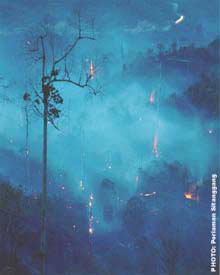
At last, one study which looks at the overall emissions from biodiesel made from palm oil grown in South-east Asian peatlands will soon be published in a journal.15 This study uses very conservative figures: It counts emissions from peat drainage, but not from the vast annual fires set by plantation owners. From those conservative figures, it finds that a tonne of palm oil used for biodiesel from peatlands in that region is linked to the emission of 10-30 tonnes of CO2. This is 3.6 to 10.9 times as much CO2 as would be emitted from burning the same amount of diesel. This is the only independent study on life-cycle emissions for a tropical biofuel feedstock which I have ever seen.

The sustainability promise:

I have seen no scientific paper nor pro-large-scale biofuel institution which agrees with destroying rainforests to make way for energy crops – virtually all the organisations and papers which call for massive expansion of energy crops insist that this need not and must not happen. Yet, unfortunately, biofuels are being introduced into a world run largely on neo-liberal principles – or, to be more specific, within trade rules which have a strong bias against regulation and any ‘trade restrictions’ to protect the environment, the climate or communities. Where crops are grown is, by and large, determined by the market – not by scientists and NGOs drafting maps and plans. The market favours those biofuels which are cheapest. Generally that means those with the highest yields, which are tropical starchy and oily plants such as palm oil and sugar cane. Lower-yield crops can capture the market if costs are kept low and governments guarantee an unlimited supply of new land and perhaps even subsidies – soy biodiesel being a prime example. Rainforests, biodiversity, healthy soil and clean water and greenhouse gas emissions remain ‘externalities’ in the accounts, which will inevitably be sacrificed for real quick profits. Take the Indonesian example: Although sustainable oil palm monocultures may be an oxymoron, Indonesia could at least tell its plantations companies that they should plant on the 12 million hectares of rainforest land which they already clear-cut and then abandoned, rather than granting them ever more concessions for new forest land. But plantation companies make far more profits by selling timber than by growing palm oil alone – and they are powerful enough to stop policies which would cut into those profits.

So here is what we are witnessing just now:

Governments, institutions, NGOs and scientists are writing studies, many of them with dodgy claims, which show that biofuels could be grown without destroying any more rainforests, wetlands, peatlands, or biodiversity hotspots. As a result, new markets are created which dramatically up the world market prices of palm oil, soy and sugar cane. On the ground, plantation owners respond by growing more of those crops in the Amazon, in Uganda’s rainforests or in Colombia’s ancient forests and grasslands – unimpeded by regulations and unimpressed by those who tell them that they could be growing them somewhere else. Trade rules, meantime, do not allow for discrimination on goods because of the way they have been produced. Even if Europe might get away with a ban on deforestation diesel, they don’t even want to try. Instead, there is a growing push to use biofuel expansion as a tool for pushing through further trade liberalisation and further barriers to regulation and environmental safeguards in the World Trade Organisation.16

Meantime, companies, like Wilmar International, sign up to the principles of the Roundtable for Sustainable Palm Oil (perhaps safe in the knowledge that they won’t be translated into action probably for years to come), then apply to destroy one of Uganda’s largest rainforsests for a new oil palm plantation and still manage to get World Bank funding.17 In the absence of regulation, certification might at best tell consumers that the particular palm oil they are using comes from rainforest which was chopped down before 2005 whereas less scrupulous customers can get that from more recently destroyed forests. Yet, wherever the particular palm oil delivery came from, burning it will drive up the world market price and boost the profits of the worst and the less bad plantation owners alike.

Biofuels, not climate justice

One of Britain’s leading carbon capitalists and biofuel advocates is James Cameron, founder of Climate Change Capital. He is a long-standing opponent of equal rights to the atmosphere, and an influential supporter of the Kyoto Protocol and its inequitable carbon market. This is how he sets out his dire vision for Africa’s future: “The Africans are in a perilous position. They will not be rescued by 20 years of debate about C&C. Nor will they be rescued by the Carbon Market [or] beneficiaries of [it]. They’re going to have to really look to the possibilities that do exist in altering their economies to cope with very high fossil fuel prices and Climate Change at the same time . . . some combination of looking at land use and land use change issues; of coping more effectively with the water resources which are there; of growing biocrops; of ensuring that renewable energy technology is made available at low cost.”

This is a frank admission by one of the architects and profiteers of the carbon market. He continues to advocate an extension of the present-day unsuccessful and inequitable carbon trading, knowing full well that it will not save Africa from being devastated by climate change, and that the carbon trade will not benefit its people. It does, however, benefit him: Having helped to put the current emissions trading in place, he is now Chief Executive of a very successful merchant banking group which has just raised $380 million under Europe’s Emissions Trading Scheme, money which they will invest in ‘low carbon’ projects primarily in developing nations. Climate Change Capital will be speaking at the Bioenergy Europe Conference in February 2007, a conference which will outline “the latest EU legislation and incentive schemes that aim to produce a dramatic increase in the use of biomass and biofuels across the 25 member states.”18 Clearly, biofuels are a profitable investment opportunity. The above quote about Africa’s future was published by Aubrey Meyer, founder of the Global Commons Institute, who comments: “Cameron adds Africa to the growing pile of discards that the C3 scenario [i.e. the Kyoto Protocol] inevitably causes and the economics of genocide inevitably requires.”19

Where should we stand?

Many European environmentalists have had high hopes for sustainable local biomass from waste or community forestry. We can hold on to those ideals and many small co-operatives are trying to put them into practice. In poorer, low-energy societies, even a small amount bioenergy, from waste or intercropping, could make a real difference to people’s lives – provided that they are able to use it for their benefit, not export it to the richer nations.20

We must remember, though, that biomass from waste will only meet a tiny proportion of our energy demand – there is little chance of it having any measurable impact on our greenhouse gas emissions. Above all, we must remember that the EU Biofuel Directive, UN policies, bilateral biofuel agreements, etc. have nothing whatsoever to do with this ‘green’ idea. They are putting a global blueprint into action which is threatening local communities, biodiversity, water supplies, rainforest and the climate across the globe. If people think that they can sit at stakeholder forums and make this blueprint sustainable then they should take some time out for reading: I would recomment those papers listed above which set out the global biofuel vision, the Millennium Ecosystem Report, and some good summary of climate change impacts.

As one UN Agency, international institution and government after another adopts this global blueprint, or adjusts its policies accordingly, we need to study the plans, and unite for the rights of the hundreds of millions of people who live on land conveniently classed as ‘degraded wastelands’ which are up for grabs. We need to stop the web of biodiversity being destroyed by monocultures grown in the name of climate change mitigation. And we need to speak out against anybody, no matter their scientific degree or qualification, who claims that monocultures can stabilize the climate. There can be no sustainable energy system based on monocultures. Today’s bioenergy revolution is already destroying some of the planet’s vital climate sinks and threatens to greatly accelerate the pace of global warming. Accelerated global warming threatens all our future. We have the evidence. What we now need is a strong global opposition.

  1. See, for example, the editorial in Nature, one of the two most prestigious scientific journals, 7th December 2006
  2. http://www.stabilisation2005.com/outcomes.html
  3. http://www-g.eng.cam.ac.uk/impee/topics/stabilisationwedges/files/Stabilisation%20Wedge%20v1%20PDF%20WITH%20NOTES.pdf
  4. To find out more about the reality of ‘reforestation’, see www.sinkswatch.org/ .
  5. http://www.iaee.org/documents/p03read.pdf
  6. http://www.bioenergytrade.org/otherreportspublications/fairbiotradeproject20012004/quickscanofglobalbioenergypotentialsto2050/index.html
  7. For an example of a bioenergy ‘zoning’ map of Africa, see http://biopact.com/2006/06/sneak-preview-of-biofuels-atlas-great_18.html
  8. “Drink the best and drive the rest”, Nature, 7th December 2006
  9. http://www.earth-policy.org/Updates/2006/Update61.htm
  10. http://news.independent.co.uk/environment/article1786829.ece
  11. http://www.pecad.fas.usda.gov/highlights/2006/06/europe_20_june_2006/
  12. http://www.fao.org/newsroom/en/news/2006/1000365/index.html
  13. http://www.iwmi.cgiar.org/press/coverage/Food%20biofuels%20could%20worsen%20water%20shortages_Reuters.com.pdf
  14. There are studies which look the energy efficiency of tropical biofuels, particularly sugar cane, and there is information about carbon savings from fossil fuel replacement, but no full life-cycle study, which would need to include land-use change emissions.
  15. http://www.wetlands.org/news.aspx?ID=804eddfb-4492-4749-85a9-5db67c2f1bb8 Please note that we have derived at the comparison with diesel by using conversion tables found here http://bioenergy.ornl.gov/papers/misc/energy_conv.html .
  16. http://www.bbj.hu/latestnews/news_21130_biofuel%2Bdemand%2Bwill%2Bmake%2Bwto%2Baccord%2Bpossible.html
  17. http://www.wrm.org.uy/bulletin/100/Uganda.html
  18. http://www.climatechangecapital.com/index.asp (see events for details of the conference)
  19. http://lists.topica.com/lists/GCN@igc.topica.com/read/message.html?sort=t&mid=1720498412
  20. see: http://www.cures-network.org/docs/pos_2006_biofules_brochure.pdf

January 2007

Almuth Ernsting

Biofuelwatch

www.biofuelwatch.org.uk

info [At] biofuelwatch.org.uk

Labels: , , , ,

Climate Change Action

Home furl google deliciousdel.icio.usnetvouz newsvine diggDigg This!reddit spurl Technorati

Enter your Email


Preview | Powered by FeedBlitz

Monday, January 08, 2007

Report of the Week: Livestock's Long Shadow

This week's report of the week (large pdf) focuses on the role of livestock in key environmental challenges. The production of beef is found to be one of the most nutrient and carbon intensive industries on the planet aswell as being a significant driver of deforestation.

"Overall, livestock activities contribute to an estimated 18% of total anthropogenic greenhouse gas emmissions from five major sectors of greenhouse gas reporting:energy, industry, waste, landuse change and forestry (LULUCF) and agriculture."
By far the largest numbers are due to LULUCF activities such as deforestation to expand ranchland.

Report summary:
"This report aims to assess the full impact of the livestock sector on environmental problems, along with potential technical and policy approaches to mitigation. The assessment is based on the most recent and complete data available, taking into account direct impacts, along with the impacts of feed crop agriculture required for livestock production.

The livestock sector emerges as one of the top two or three most significant contributors to the most serious environmental problems, at every scale from local to global. The findings of this report suggest that it should be a major policy focus when dealing with problems of land degradation, climate change and air pollution, water shortage and water pollution, and loss of biodiversity.

Livestock’s contribution to environmental problems is on a massive scale and its potential contribution to their solution is equally large. The impact is so significant that it needs to be addressed with urgency. Major reductions in impact could be achieved at reasonable cost."

Labels: , ,

Climate Change Action

Home furl google deliciousdel.icio.usnetvouz newsvine diggDigg This!reddit spurl Technorati

Enter your Email


Preview | Powered by FeedBlitz

Thursday, December 14, 2006

Climate Blog Highlights: Monsoon Rains, Carbon Credits, Budget Breakdown, Reforestation...

David T the Low Carbon Kid has a breakdown of the environmental measures announced in Gordon Browns' pre-budjet report. This is a better summary than i have seen up to now so check it out if you are interested in seeing just how green the Labour government is.

There is an interesting article about forest preservation and reforestation in South Africa here, via the CDM blog.

There is a post about the impending refugee crisis due to climate change over at the Climate Progress. There is also a post about the link between extreme rainfall during India's monsoon season and climate change.

Dave Sag over at the Carbon Footprints blog has several interesting posts recently, first off there is apostabout a recent feasibility study looking into carbon credits (AKA carbon rationing, AKA domestic tradeable quotas, AKA all sorts of things). This study (pdf) as carried out at the request of environment minister David Miliband who also has a blog. If you are interested in this idea you may also be interested in another report on the topic by the Tyndall Centre. Dave also highlights many other interesting stories some of which will receive blog postings in there own right on my blog later.

Labels: , , , , , , , ,

Climate Change Action

Home furl google deliciousdel.icio.usnetvouz newsvine diggDigg This!reddit spurl Technorati

Enter your Email


Preview | Powered by FeedBlitz

Wednesday, December 06, 2006

REDD -- REDucing emissions from Deforestation

I recieved the following email in the daily round of notices form the IISD's Climate-L mailing list. If you are interested in climate policy you should probably tollerate the high traffic and subscribe, there is lots of interesting info available.

Dear climate-l readers,

we would like to make you aware of an
article discussing recent developments regarding the issue of reducing emission
from deforestation (REDD). The publication also provides estimates for the
potential market value of an international mitigation scheme and for potential
incomes of individual countries.

The article - entitled “Nairobi talks made progress on forest conservation for global warming emissions credits - is available at on here.

The research paper analyses key implications of different international policy approaches for the environmental effectiveness of an agreement on REDD, as well as for its economic and political attractiveness to different stakeholders. It also addresses potential co-benefits of carbon trading solutions for biodiversity conservation and sustainable development, suggests ways to maximise synergies, and considers solutions to several unresolved negotiation issues.

Comments are highly welcome!

Johannes Ebeling Consultant EcoSecurities Direct +44 (0)1865 264 010 Mobile +44 (0)770 799 2110 Tel +44 (0)1865 202 635 Email johannes.ebeling@ecosecurities.com www.ecosecurities.com

Save This Page as a del.icio.us favourite

Labels: , ,

Climate Change Action

Home furl google deliciousdel.icio.usnetvouz newsvine diggDigg This!reddit spurl Technorati

Enter your Email


Preview | Powered by FeedBlitz

Monday, November 20, 2006

NPower and Palm Oil


Before the plantations comes the deforestation. After planting
palms a biological desert is replaced with a monoculture.


Cattle ranching is well known as a driver of deforestation. Another, more recent, but equally disturbing factor that is increasingly worrying both climate activists and indigenous groups is the rapid expansion of palm oil plantations.

Ostensibly in the name of sustainable development and carbon neutrality, in reality the expansion is largely a result of poor regulations and rampant free market capitalism.

For a short briefing on some of the related issues see this short report by Friends of the Earth. For a more detailed look try this report by Environmental Defense or a whole collection of sources on the biofuelwatch website.

In the face of this threat, a british company NPower has decided to commission a power plant to run on palmoil. So in the name of sustainability a british power company has decided to drive deforestation in the tropics and ship in the so called 'carbon neutral' fuel from the other side of the globe four us to claim as progress in climate mitigation.


Don't think this sounds like a good idea? Please send the following email to the email addresses bellow (Corporate Social Responsibility and Public Relations).

---
anita.longley[at]rwenpower.com
richard.frost[at]npower.com
---

Dear [Sir or Madame],

I am deeply concerned about your plans to burn palm oil in power stations under the Renewables Obligation.

The Renewables Obligation is supposed to help companies develop clean, climate-friendly technologies and a viable domestic renewable energy sector. Palm oil comes from rainforest nations and is neither clean nor climate-friendly. Millions of hectares of virgin rainforests have already been destroyed to make way for oil palm plantations. Local communities have their land taken from them and often suffer human rights abuses. The peat and forest fires in Indonesia alone account for three times the greenhouse gas emissions which the Kyoto Protocol sets out to save.

Burning palm oil in power plants will further drive up the price of palm oil, and make rainforest destruction ever more profitable - even if you were to buy from ‘certified’ sources. This is a travesty of the idea of ‘renewable energy’. Your customers want you to invest in truly renewable and sustainable energy, such as wind and solar power, and small-scale sustainable biomass grown locally. Please drop your plans now and assure me that palm oil, palm kernel (containing useable animal feed) and other tropical feedstocks linked to deforestation will not be used by Npower under the Renewables Obligation.

I look forward to your reply. Many thanks in advance.
Yours faithfully,

Labels: , ,

Climate Change Action

Home furl google deliciousdel.icio.usnetvouz newsvine diggDigg This!reddit spurl Technorati

Enter your Email


Preview | Powered by FeedBlitz

Tuesday, October 17, 2006

Outline of: From here to there...elucidating the challenge of GHG emission reduction

Here is an outline for my upcoming report on emmission levels, trends and insights.
This report build on the conclusions made in 'Climate change: Facts and Impacts".

Any comments on this?

Suggestions for reports to feed into this still welcome. List of reports currently being used available here.

1. The Carbon Cycle
> An overview in qauntitative terms.
> A caviet regarding abrupt climate change and positive fedbacks.

2. An Overview of Greenhouse gas sources.
>Current emmissions levels per sector and per region.
>Trends, total, per region, per sector.

3. Land Use Change/Agriculture
>Deforestation
>Peat Buring
>Agriculture

4. Fossil Fuel Burning
>Transport Growth
>Growth of Coal

5. Industrial Processes
>Steel
>Cement

6. Key Dynamics
>Developed vs Developing Nations.
>Difficult Challenges in long term.
>Futher insights.

Labels: , ,

Climate Change Action

Home furl google deliciousdel.icio.usnetvouz newsvine diggDigg This!reddit spurl Technorati

Enter your Email


Preview | Powered by FeedBlitz